
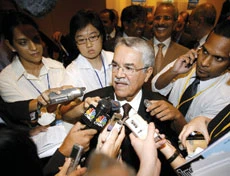
SINGAPORE, 29 November 2007 — The world oil market is well supplied and fundamentals do not support high prices, Minister of Petroleum and Mineral Resources Ali Al-Naimi said yesterday as OPEC announced a massive investment package over the next five years to boost production.
“There is no relationship between the fundamentals today and the price of oil. There is a mismatch,” he told reporters after delivering a speech at an energy forum in Singapore ahead of a key OPEC meeting next week. “Fundamentals do not support high petroleum prices. The world market is well supplied,” he said during the speech.
Asked whether Saudi Arabia, the world’s biggest oil exporter, will push for an increase in crude production at OPEC’s meeting next Wednesday, he said the group needed to see data first.
“You are trying to get a premature answer. We need to meet first, we need to look at the data and then decide accordingly,” he said.
Organization of Petroleum Exporting Countries (OPEC) President Mohammad Al-Hamli added OPEC would invest more than $150 billion by 2012 on more than 120 projects, including large refineries, to expand output.
These projects are expected to raise OPEC’s existing production capacity by over five million barrels a day, said Al-Hamli, who is also the oil minister of the third largest OPEC producer United Arab Emirates. They are also aimed at “satisfying growing demand for uninterrupted secure oil supplies, as well as offer an adequate level of spare capacity,” he said.
Al-Hamli agreed there was enough supply but declined to indicate whether OPEC would raise output at its upcoming meeting.
“We are going to meet next week and we will have a lot of information available. I’m not dropping any hints, you are going to spoil our meeting,” Al-Hamli told reporters after speaking at the same forum.
“In OPEC, when we meet as ministers, we look at the fundamentals. We look at the data and we base our decision on the data available at that time.”
Naimi said global oil supplies “are definitely comfortable and they are definitely within the five-year average, and no one can deny it. That is a fact.” He said OPEC had no control over prices being determined by the market.
“You see the (price) volatility today because of different reasons,” he said.
The Saudi minister also assured that his country, which holds a quarter of the world’s proven petroleum reserves, was committed to meeting the needs of every country. “With our massive reserves and highest spare production capacity in the world, Saudi Arabia will continue to satisfy all of its customers, helping to keep the world’s petroleum supply in balance with demand,” he said.
Al-Hamli identified refining bottlenecks, geopolitical tension, risk hedging and speculation as among the factors driving oil prices higher.
Oil fell almost 3 percent to around $92 a barrel yesterday after a US government report showed a smaller than expected drop in crude inventories in the world’s top consumer. Crude inventories fell by 400,000 barrels last week, the US Energy Information Administration said, less than the 900,000-barrel drop analysts expected. Stocks of gasoline posted a larger than expected rise.
US oil was down $2.55 at $91.87 a barrel by 1616 GMT, after falling $3.28 on Tuesday. Brent crude lost $1.87 to $90.65.
In the afternoon Asian trade New York’s main contract, light sweet crude for January delivery, slumped 25 cents to $94.17 per barrel from $94.42 in late US trades Tuesday.