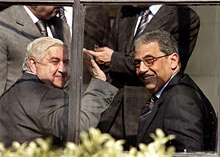
BEIRUT, 7 January 2008 — Lebanon’s feuding politicians yesterday welcomed a decision by Arab states, including Syria, to back the head of Lebanon’s Army as the next president, expressing hope the move would help end the country’s political crisis.
Arab foreign ministers issued the endorsement of Gen. Michel Suleiman on Saturday after meeting in the Egyptian capital of Cairo. Syria’s willingness to back the statement put pressure on the Lebanese opposition — led by the Syrian-backed Hezbollah group — to drop its demand that it receive Cabinet veto power before allowing Suleiman to be elected.
Parliament Speaker Nabih Berri, who is allied with the opposition, thanked the Arab ministers for their call, saying “we hope that it will be translated on the ground to ward off any strife and end the current crisis.”
“I tell the Lebanese that we can start with the Arab resolution to... confirm our unity,” Berri added in a statement released by his office.
Saad Hariri, head of the anti-Syrian parliamentary majority, echoed Berri’s endorsement, describing the resolution as a “historic stance that expresses the real Arab will in rejecting all kinds of pressure on our country.”
“It also gives the Lebanese people moral, political and national support that will enable them, God willing, to overcome the current crisis,” he added.
The ruling coalition has accused the opposition of obstructing the election of a new president under orders from Syria and Iran. In turn, the opposition has claimed pro-government groups in the Parliament majority follow US policies.
Lebanon has been without a president since President Emile Lahoud’s term ended Nov. 23. The crisis over the presidency has capped a yearlong power struggle between anti-Syrian politicians, who hold a slim majority in Parliament and support the Western-backed government of Prime Minister Fouad Siniora, and the pro-Syrian opposition.
Lawmakers on both sides have agreed to back Suleiman as a compromise candidate, but the Parliament must first amend the constitution to allow a sitting military chief to become president.
This process has been complicated by the opposition’s demand for a new unity government that would give it veto power over major decisions. Opposition boycotts have thwarted attempts to choose a president by preventing a two-thirds quorum.
The Arab foreign ministers statement called on Lebanon first to elect Suleiman on Jan. 27, then resolve the issues surrounding a national unity government. The ministers also said the new president should have the power to cast his vote to break ties in the Cabinet.
Hezbollah legislator Hassan Fadlallah said the opposition will “openly discuss the Arab initiative because it (the opposition) is keen to find a solution to the political crisis.”
Despite the decision by the Arab ministers not to support opposition veto power, Fadlallah praised their statement for addressing both the need to elect a president and form a new national unity government.
Meanwhile, Arab League Secretary-General Amr Moussa said yesterday in Cairo that US President George W. Bush has the responsibility to move the Middle East peace process forward after he held the November Annapolis talks. Ahead of the president’s visit to the region, Moussa said that while he shared the misgivings of many in the Arab world about the intentions of the US president, he hoped to see concrete developments during the trip.
“We will be waiting to see what the US offers during the upcoming visit of President Bush, who bears the responsibility of moving the process forward as the one who called the Annapolis meeting,” he said at the conclusion of the two-day Arab foreign ministers meeting.
“I share your fears and misgivings,” he said to an Egyptian journalist about Bush’s intentions, “but in political and diplomatic work.
In their final statement, the ministers expressed grave concern over the situation in the Palestinian territories since the conference in Annapolis last November.
“There has been no change on land regarding the building of settlements, the isolating wall, the removal of unauthorized settlements, the continued call for new tenders to build and expand settlements and carrying out geographic and demographic changes, especially in the occupied East Jerusalem,” the statement said.