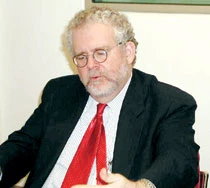
JEDDAH, 24 January 2008 — Walter Russell Mead, Henry A. Kissinger Senior Fellow in US Foreign Policy at the Council on Foreign Relations, said that the war on Iraq is a lesson that is going to make a historic change in both the East and the West.
“Working with Arabs, trusting them and building relationships with them is the key to protecting their lives. God makes good come out of evil. Maybe the long-term consequences of this terrible war are going to be better than we expected,” said Mead at a roundtable discussion yesterday at the US Consulate General here.
When asked about the achievements of the “war on terrorism,” Mead said with a grin: “If you can keep George Bush safe in the Middle East when every terrorist in the region would want to kill him, then you can be sure you’ve achieved something.”
Introduced as “not affiliated with the US government nor is he a member of the Republican Party,” Mead explained that during his 10 years on the council, he has studied various concerns and issues from a historical focus rather than a theoretical one. He has spent time traveling in the Islamic world, visiting countries such as Indonesia, Sudan, Bosnia-Herzegovina, Turkey and Pakistan, attending academic conferences and talking to religious scholars and people in order to learn about what is happening out there.
“I’ve wanted to visit Saudi Arabia since 9/11. As a member of the largest think tank on foreign relations in the US, I feel that my education and knowledge isn’t complete without visiting the Kingdom,” said Mead. “People now understand the US in a new way. Our strategies are not having the results we wanted. But I don’t think our learning process or policy reform has finished. Americans want a better relationship with the Middle East.”
While Palestinians have been facing an Israeli blockade for days, Mead — who formerly visited Gaza and the West Bank — believes that there are two important elements that need to be taken into consideration regarding the Israeli-Palestinian conflict. The first is the settlement and reconciliation between Israelis and Palestinians and the second is to have a road map for the future of Palestinians.
“People among Palestinians are ready for peace with Israel. If they sign an agreement in Jerusalem, what happens next? What is the arrangement for these people? We have to think of the human problems of Palestinians. When peace comes, every Palestinian must have a future,” said Mead.
As for the current state of the US economy, and after President Bush urged that an economic stimulus package worth nearly $150 billion be passed to head off a nationwide slump, Mead hopes that the long-term outlook for the US economy remains good. He believes that it is time for the Organization of the Petroleum Exporting Countries (OPEC) to pass a similar stimulus package.
“Despite Bush’s stimulus package, fears of US recession persisted causing the stock market to crash worldwide. It means we’re all in this together. It’s time for OPEC to pass a stimulus package to get the world going,” he said.
Walter Mead’s book, “Special Providence: American Foreign Policy and How It Changed the World,” was widely hailed by reviewers, historians and diplomats as an important study that would change the way Americans and others think about the US foreign policy.
His most recent book, “God and Gold: Britain, America and the Making of the Modern World,” is a major study of 400 years of conflict between Anglophone powers and rivals, ranging from absolute monarchies, such as Spain and France, through Communist and Fascist enemies in the 20th century to Al-Qaeda today.