
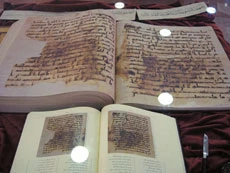
A new Islamic cultural center in Qatar takes a modern innovative approach toward informing non-Muslims about Islam. It links fundamental Islamic principles with fresh means and styles. Fanar, Qatar’s Islamic Cultural Center, is a charitable organization that works to motivate non-Muslims to become more informed about Islam by illustrating Islamic culture through multiple styles and means that include exhibitions, Arabic language courses and sports activities for both men and women. The Prime Minister and Foreign Minister of Qatar, Sheikh Hamad bin Jassim Al-Thani, officially opened Fanar, an affiliate of the Qatar’s Ministry of Endowments and Islamic Affairs, on Jan. 13, 2008. At the same time, the minister also opened the Expo of Arabic Calligraphy and Rare Islamic Manuscripts.
Fanar, a word that means fluorescent floodlight, was chosen as the name of the center in order to suggest its mission as a guiding light for non-Muslims toward Islam as a way of life. The building, with its state-of-the-art beautiful Islamic-inspired architectural design and ornaments, located on Doha’s Corniche also reflects this mission as well as the combination of heritage and technology. The building is impressive and welcoming, in a prime location in Doha, and the staff is all-smiles and hospitable, putting all who enter at ease.
In his speech at the opening, the Qatari Minister of Endowments and Islamic Affairs and Board Chairman of Al-Waqf Authority Faisal bin Abdullah Al-Mahmoud, said that the center sought to give prominence to human values, the concept and meaning of Islamic civilization, exert efforts to increase the understanding of Islam and invite others to Islam. “The target is also to have Islam address the requirements of the modern age through sermons, practice, contributions and endowments,” he said.
With these objectives in mind, since it opened six months ago, the center has offered Arabic language courses at different levels to diplomats and their spouses and children, some non-Arab media personnel at Aljazeera satellite channel which is based in Qatar, doctors and personnel from the Education City campuses of Texas A&M University, Carnegie Mellon University, Virginia Commonwealth University and Georgetown University. Other services provided, all for free, include Islamic culture, arts and calligraphy expos and courses in Shariah science and discipline, a program entitled ‘Discover Islam’ and a program of patient visits following in the footsteps of the Prophet (PBUH) in visiting the sick of all nationalities and faiths.
The Islamic Art Expo, opened by the Qatari prime minister on Jan. 13, contains works of art from China, Turkey, Qatar and Egypt, from past and present and include works by Fuat Basher, the Turkish master of Abro paper art, Obaidah Al-Bankee, the internationally renowned Syrian in Arabic calligraphy, Mumtaz Durdu, the innovative Turkish Islamic artist, and Haji Nooredeen, the Chinese calligrapher who has combined Arab and eastern styles to make his own school of design. All held workshops in their craft for visitors.
Alongside this was a display of a rich collection of artistic items illustrating brass work, ceramics, Abro paper, architecture, woodwork and fabric from past centuries. Most of these items were provided by the Istanbul-based Research Center for Islamic History, Art and Culture (IRCICA), a subsidiary organ of the Organization of the Islamic Conference (OIC). Among the items displayed is a recently published book with a critical edition of an original copy of the Holy Qur’an attributed to the time of Caliph Othman (may Allah be pleased with him). This is the copy known as the ‘Othman Mushaf (Qur’an copy)’ located in the Topkapi Palace Museum in Istanbul. The ‘Othman Mushaf’ is one of the oldest manuscripts of the Holy Qur’an that survived to the present day. With only two pages (23 verses) lacking, ‘Topkapi Mushaf’ is closest to the complete text of the Qur’an.