
RORY Stewart, a Scottish writer, was born in 1973 in Hong Kong. He studied history and philosophy at Eton and Balliol College, Oxford. He was an officer in the British Infantry (the Black Watch) for a brief period. Later he joined the Foreign Office. “He served in the British Embassy in Indonesia from 1997 to 1999, as the British representative to Montenegro in the wake of the Kosovo campaign and as Coalition deputy governor of Maysan and senior adviser in Dhi Qar, two provinces in southern Iraq during 2003-2004. From 2004, he was a Fellow at the Carr Center for Human Rights Policy, Harvard University, United States.” From 2000-2002 he walked across Iran, Afghanistan, Pakistan, India and Nepal, a journey of 6,000 miles.
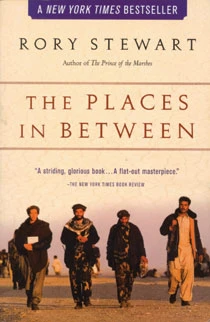
His first book, “The Places in Between” (2004) sheds light on his experiences in Afghanistan. A New York Times best seller, it “won the Royal Society of Literature Ondaatje Prize, a Scottish Arts Council Prize, and the Spirit of Scotland Award in 2005 and was short-listed for the Guardian First Book Award and the John Llewellyn Rhys Prize. The book was adapted into a radio play by Benjamin Yeoh and was broadcast in 2007 on BBC Radio 4.”
During his arduous journey, Rory was able to communicate with a most misunderstood people, the Afghans. In this fascinating book, he provides glimpses of Afghan society. During his long walk on the forgotten path of the first Indian Mogul Emperor Babur, Rory finds the remains of many vanished civilizations, forgotten religions, political systems, pastoral, agricultural and martial societies. When talking about Afghans, he seems sympathetic to their religion and social values. He provides a great deal of interesting information about the past and present of Ghazni, Ghor and Chisht. These tiny mountainous kingdoms ruled neighboring giant India for many centuries. He wonders whether there is any genius remaining in the residents of these places.
He laments the looting of ancient artefacts, antiquities and valuables from these ancient kingdoms by punk diggers. Now in the place of the artistic treasures is only the debris scattered around the trenches, still hinting at how unusual and important this culture was. He says, “The Turquoise Mountain was only the most dramatic and most recent victim of a general destruction of Afghanistan’s cultural heritage. The demand for these historic objects and the money for the excavations came from dealers and collectors, predominantly in Japan, Britain and the United States. A month after I left the village, items from Jam — described as Seljuk or Persian to conceal their Afghan origin — were being offered on the London art market.”
He says that after the downfall of the Taleban, the villagers began digging and sold whatever they found for a cheap price. Now these artefacts are available on the international market at high prices. The Taleban dynamited the Bamiyan Buddhas and committed other outrages but they never allowed anybody to loot the cultural treasures, he says. During their rule, the roads and cities were safe.
He again says, “I was clearly wrong in assuming American operations had had little effect on this valley — they freed up the antique smuggling market. As an Islamic site, Jam had been relatively well protected during the Taleban period.”
He portrays Afghans as selfless, hospitable, brave and fiercely independent for whom Islam is the only guiding and binding force through which they can make a dialogue with other civilizations. While seeing a Qur’an in the hands of an Ethnic Hazara Ali, Rory says, “There was no Pepsi in this village; the global brand was Islam. Ali thought the only thing he and I had in common was the Qur’an and I would understand that anyone who burned the book, even accidentally, would be damned for sacrilege. He didn’t think foreigners would be interested in deaths in his family. In a way he was right. Westerners paid little attention to the killing of the Hazara. What moved them was the destruction of the Bamiyan Buddhas or the fate of the lion in the Kabul Zoo. In Britain and the United States nine hundred thousand dollars was raised for the lion. Tony Blair paid particularly close attention to the Qur’an, but Ali would have had difficulty understanding Blair’s view of it.
On Sept. 20, 2001, Blair packed his Qur’ans for a tour of the Middle East. Months earlier, he had told an interviewer he possessed two editions. Now according to the Guardian, he had three. “Blair,” it stated, “now carries a copy of the Qur’an at all times for “inspiration and courage — a habit he picked up from President Clinton’s daughter.” Blair encouraged Muslims to study their holy book before Sept. 11, telling readers of the Muslim News, “The concept of love and fellowship as the guiding spirit of humanity is so clear... if you read the Qur’an.” On Oct. 7, speaking of the 9/11 hijackers, he said: “The acts of these people are contrary to the teachings of the Qur’an... It angers me as it angers the vast majority of Muslims.”
Blair’s handling and discussion of the Qur’an would have struck Ali as highly eccentric. In Ali’s view, Blair could not have read the Qur’an because Blair could not read Arabic. Since the Qur’an is, unlike the Bible, the actual words spoken by God, spoken through Muhammad (peace be upon him) in Arabic. A translation is not considered to be the Qur’an. At times, it has been considered blasphemous to translate it at all.
Ali carefully wrapped his Qur’an, kept it in a wooden box on a high shelf, and approached it only after ablutions and with a prayer. He would have been horrified to see Blair thumb through his translation on a plane or to hear Blair make confident statements about its meaning. The Qur’an’s dense network of metaphor, poetry and allusion is traditionally interpreted with reference to the Hadiths (sayings) of the Prophet and long traditions of legal and theological exegesis. As a result, public pronouncements on the meaning of the Qur’an are usually reserved for the most learned and senior of mullahs.
Rory’s observations about the role of the UN in Afghanistan are very valuable: “In a seminar in Kabul, I heard Mary Robinson, the UN High Commissioner for Human Rights, say, ‘Afghans have been fighting for their human rights for 25 years. We don’t need to tell them what their rights are.’” According to him, the head of a major food agency added privately, “Villagers are not interested in human rights. They are like poor people all over the world. All they think about is where their next meal is coming from.” Then he adds, “The differences between the policy-makers and a Hazara such as Ali are much deeper than a lack of food. Ali rarely worried about his next meal. He was a peasant farmer and had a better idea than most about where his next meal was coming from. If he defined himself it was chiefly as a Muslim and a Hazara, not as a hungry Afghan. Without the time, imagination, and persistence needed to understand Afghans’ diverse experiences, policy-makers will find it impossible to change Afghan society in the way they wish to change it.”
Rory was very impressed by the Mogul Emperor Babur. As he mentions in the beginning of the book, he is unable to express why he walked through Afghanistan but he says one of the reasons might be his love for adventure. He says that while crossing Afghanistan in the footsteps of Babur he decided to walk the central route from Herat to Kabul because it was shorter and because the Taleban were still fighting on the main southern route. This book, like Babur’s “Tuzuke Babri,” is a daily diary of the events during this long and dangerous journey. Rory provides details about his host warlords, their sphere of influence and common Afghans who gave him food and shelter. He paints a live picture of the Afghan countryside where very few foreigners ever dare to go. He, without any bias, provides detail of the rich and poor and the literate and the ignorant. His description of the Afghan mountain range and its flora and fauna is very interesting.