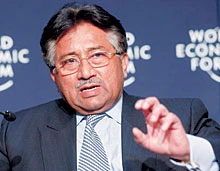
DAVOS, Switzerland, 26 January 2008 — President Pervez Musharraf of Pakistan said here yesterday that there was a “zero percent chance” of terrorists getting hold of his country’s nuclear weapons and that he expected a return to democracy after elections, planned for February.
Speaking at a breakfast hosted in his honor by well-known Pakistani defense analyst Ikram Sehgal, Musharraf said that the only way for militants to gain access to Pakistan’s nuclear arsenal would be if Al-Qaeda or the Taleban defeated the Pakistani Army entirely, or if extremists won next month’s elections.
“Both these possibilities are imaginary. We cannot be defeated,” he said.
Musharraf said the Pakistan Army was a highly professional, motivated and well-trained force, and it is capable of safeguarding and securing nuclear assets against all kinds of threats.
“Nothing of that sort is going to happen,” he said, referring to Western fears about the security of Pakistan’s nuclear assets. “Pakistan is a nuclear state, and it is unfortunate that the world sees it as unstable and is concerned that its nuclear assets could fall into the hands of terrorists. Since we are a nuclear state, let me assure you that we have multilayered command-and-control system in place. There is no way that these assets can fall into the hands of the terrorists.”
Musharraf added the general elections would go as planned.
“Elections will be held on Feb. 18. They will be free, fair and transparent,” he said. “I firmly believe that the democratic transition and elections in February must lead to a stable government — a politically reconciled government.”
Pakistan, he said, has adopted a multipronged strategy to fight terrorism. “It means military, political and socioeconomic fronts. We are fighting terrorism and extremism in a holistic manner. Pakistan will defeat Al-Qaeda militarily,” he added. “They are foreigners and armed to the teeth, and they have to be defeated militarily,” he said.
Pakistan has complete cooperation with US intelligence at both the strategic and tactical levels in fighting terrorism, he said.
Musharraf reacted angrily to a question from Human Rights Watch representative Kenneth Roth that the credibility of elections had been undermined by his sacking in November of Pakistan’s Chief Justice Iftikhar Chaudhry and other judges of the Supreme Court. “How can the court now be the final arbiter in the event of any legal challenge to the election result on grounds of fraud?” asked Roth.
“Please, look at Pakistan from Pakistani eyes — not with the eyes of your misconceived Western views of human rights and democracy,” Musharraf told Roth and insisted that the judges had been sacked for “corruption and nepotism” and said the independence of their replacements was not in question. “I am a victim of misconception and distortion,” he said. “I have upheld the Constitution of Pakistan.”
Musharraf said he is prepared to work with any political party that garners a Parliamentary majority in the elections. “I do not find any difficulty to work with any political party,” he said. “Whoever becomes prime minister will be chief executive and free to form the government and run its affairs.”
In another important session here yesterday, Chinese Vice Premier Zeng Peiyan said China’s economy was an integral part of the world economy. Therefore, conditions that are conducive to global development present opportunities to China; negative factors affecting global development also are challenges to China’s development.
“We in China are ready to work with the international community to address these risks and meet these challenges and contribute to economic stability and sustainable development in the world,” he said.
Zeng noted that while world global growth was 5 percent last year, China’s real GDP growth in 2007 was 11.5 percent. “During 2007, China added 12 million urban jobs,” he said, adding that he expected this level of growth to continue despite “many problems still standing in the way of steady growth in the global economy.” Zeng said he looked forward to working with multilateral institutions and international organizations to “harness the power of collaborative innovation, pursue win-win cooperation, seize opportunities together and share the benefits of development.”