
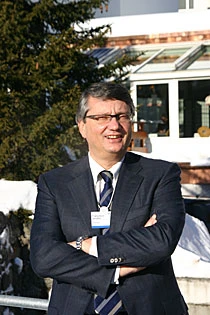
JEDDAH, 5 February 2008 - The World Economic Forum in Davos is a well-established meeting place for government and business leaders. The truth is you never know who you might encounter at the event and it wasn't a big surprise to find Francesco Serafini, Hewlett-Packard's senior vice president and managing director for Europe, Middle East and Africa (EMEA). In that position since 2005, Serafini chairs the regional leadership team responsible for HP's strategy in EMEA, developing partnerships and key stakeholder relations.
US-based HP focuses on simplifying technology experiences for all of its customers - from individual consumers to the largest businesses. With a portfolio that spans printing, personal computing, software, services and IT infrastructure, HP is among the world's largest IT companies.
Serafini has more than 20 years' experience in the IT industry. Most recently he acted as senior vice president of the Technology Solutions Group, EMEA. Prior to this current role, he was senior vice president of HP Services. In this last position, he focused on developing the business as a leader in the provision of enterprise IT services, products and software in EMEA leading a work force of 24,000 IT professionals.
The Middle East is one of HP's fastest growing markets and Serafini visited Saudi Arabia twice last year. He has a clear understanding of the dominant role the Kingdom plays in the Middle East when it comes to IT. During an exclusive interview with Arab News, Serafini spoke at length about his company's activities in the Middle East, its commitment to the region, its involvement in IT and economic projects and the importance of HP's participation in this year's World Economic Forum.
"There are too many reasons for being at Davos. This is a very interesting event where you can share ideas with many people in a very informal setting," Serafini said. "Many of our customers and many of our partners are here so it is important for us to be here. If you look at this year's WEF theme, it all about collaboration, both in terms of political environment and business environment. This theme is also at the core of our company philosophy. We feel very comfortable being here because this conference connects the world. And also because we are a truly global company. More than 65 percent of our business is outside of the United States."
Serafini is of the opinion that unlike some other global gatherings Davos continues to grow more relevant each year. "If you go back two or three years, I think now there is much more focus on business subjects. Many more business people are coming here now. There is a lot of focus on world economy. All the sessions related to economy were packed. I think Davos has evolved a lot for the good of all."
Serafini sees huge potential in the Middle Eastern market. "For the last two to three years, our growth in this region has been very, very solid. It was in double digit which is quite significant. Recently we acquired the Atos Origin Middle East group, which is one of the Middle East's leading systems integrators. The acquisition is aimed at broadening our consulting and integration capacity in the region. This investment and tie-up is important. It indicates our commitment to the region. We are here to stay."
Serafini says he is impressed by the direction Saudi Arabia has taken. "If you look at the entire region, there is a huge investment in real estate. If you look at Dubai, most of the investment there is in real estate. All of it connected with manufacturing. Saudi Arabia is aiming to be the center of all such activity. It is a very interesting scenario."
Serafini applauds the Saudi focus on education. "Increased investment in education is a good augury. It is my understanding that most of the projects that are coming up in Saudi Arabia have enough funding. The thing is there are only a certain number of people working on these projects. So the focus on education is extremely important. We will need more local people to come onboard."
According to him, the question of skills in people is a critical one. "For sure, many companies can attract people from any part of the world. But, I believe, for the development of a country, it is very important that there is lot of development in the skills and competence of the local people. I believe that must be an integrated part of all development."
He said that during his talks with people in Saudi Arabia, he felt there was this realization. "This is a very important aspect of development. There is a lot of investment in education. We need to wait for some time to see how far they have progressed. But certainly they have taken and are taking very important steps."
There is a feeling of optimism in Saudi Arabia, he added. "I visited Saudi Arabia twice last year. In both the visits I met with government representatives and business people. The message I got was very consistent. Everybody there is very focused on the development of the country. A lot of new initiatives are being taken. There is a lot of energy and enthusiasm as far as investment is concerned."
According to Serafini, this is an encouraging sign because one part of a booming economy is funding and other is people's perception; how they feel about new technology and innovation. To capitalize on these positive indicators, HP is interested in building up local capability and productivity. "We acquired Atos precisely for that reason," said Serafini. "It has good capability around oil and gas. Now we have a very good number of skilled people. We will expand this capability."
Many of the new Saudi projects are large and complex, and Serafini believes they will "take time to be finalized. But my dealings with the Saudi Arabian General Investment Authority (SAGIA) people have been very good. We have had no problems."
Talking about HP's role in the upcoming King Abdullah Economic City, Serafini commented, "We are part of ICT. We are working with them to help design the ICT needs of the future. We are looking at how we can develop our skills, specifically ICT skills. We want to connect those cities with some of our R&D labs. This is a good opportunity for us to link our thinking of the future in product and technology. This is an amazing opportunity for both sides. One of the best opportunities for HP is to develop our own products and ideas in the country that is yearning to move forward."
It's not an issue for HP that the major projects in the Kingdom will take time to mature. "We are here for long term," stated Serafini. "That is the reason why we want local people and local managers. HP's focus will always be on customer demand; we want to bring value to the customer and make sure our portfolio reflects customer demand."
But even with considerable investment from HP, Serafini emphasized that Saudi Arabia must concentrate resources on raising the personal skills of its population. "There is huge opportunity, but one of the challenges will be to make local people available. Saudi Arabia can do many things with people from outside. But that is not a good sign. You need to have your people taking the lead in this technological revolution. My message to the Kingdom is simple: Nurture local talent."