
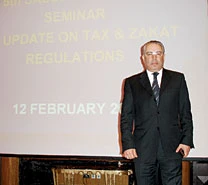
JEDDAH — Saudi Arabia’s new income tax law and its byelaws were in focus at a seminar, organized by Sami E. Farah, managing partner of Ernst & Young Jeddah, one of the world’s largest professional services firms, held here yesterday.
The seminar, which was held at Jeddah Hilton, emphasized on the update on the new tax law and its bylaws as well as clarifications issued by the Department of Zakah and Income Tax (DZIT) applicable to all Saudi businesses for fiscal years ended after July 30, 2004 whether they are taxpayers or not, under the new law. In addition, the seminar also dealt with the proposed draft zakah regulations as well as other business regulations. Recent appeal decisions and treatment of certain matters on zakah issues were also discussed during the seminar.
“The main objective of the seminar was to update and enhance knowledge and understanding of the New Saudi Income Tax Law (NITL) and zakah regulations and to inform participants about withholding taxes, tax treaties, proposed zakah regulations and other business regulations including their effect on the businesses,” Farah said during a brief introduction about the seminar.
About 150 senior executives, prominent bankers and accountants attended the seminar yesterday.
Ernst & Young is also planning to conduct such seminars in Riyadh and Bahrain next week after successfully holding the seminar in Dammam recently.
Mohammed Saleem Desin of Ernst & Young Jeddah in his presentation said that after 50 years, the Saudi government has issued a new tax law and as the case in every new regulation, this new tax law was no exception and it brought about a lot of uncertainties as to how the DZIT would interpret the New Tax Law.
With the boom in oil prices, which are hovering around $93 a barrel yesterday after touching $100 a barrel mark recently, and Saudi Arabia signing the World Trade Organization (WTO) agreement, the Kingdom has recently signed about 17 tax treaties out of which 5 have come into force. The remaining tax treaties are not yet ratified.
Desin also provided an overview of the new tax treaties and its effects.
Mohammed K. Yaghmour presented on the proposed zakah regulations and updates on zakah matters. The proposed zakah law contains about 42 articles. In addition, Yaghmour also spoke about the recent updates on zakah matters which includes the effect of new ministerial resolution No. 1005 which deals with investments in companies abroad and wholly owned subsidiaries.
Irfan Alladin focused on the updates on withholding tax matters. The byelaws and the new tax law have now deviated from territorial concept of taxation and are now taxing services even if performed out of Kingdom. This has resulted in a lot of issues arising whether a particular service is subject to tax or not and whether the tax rate is appropriate for a particular service or not. The participants were updated on the recent clarifications from the department in respect of which services are taxable and the appropriate rate applicable thereon.
Mohammed Amawi touched the topic on the latest appeal rulings on major issues. This provided an update on the recent trends of the DZIT, their assessments and how the appeal committees have taken a view on such matters.
In addition, the seminar also focused on the amendments in the companies’ regulations, salient feature of the new proposed draft company regulation as well as changes in foreign investment regulations.
Ernst & Young employs 130,000 in more than 670 cities in 140 countries. Ernst & Young Saudi Arabia is operating since 1967. Saudi Arabian offices of Ernst and Young in Jeddah, Riyadh and Alkhobar are engaged in providing professional services such as auditing and accounting, tax and zakah consulting and compliance, business advisory and consulting, and business community training.