
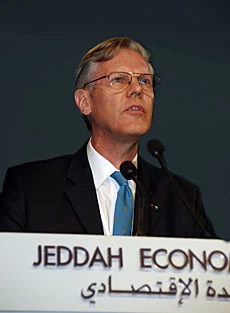
JEDDAH, 26 February 2008 — The Lord Mayor of London David Lewis made the strong ties between Saudi Arabia and the UK in the area of financial services the central theme of his speech at the Jeddah Economic Forum yesterday. Lewis told delegates that the core values of the commercial practices of Islam and the UK financial culture had much in common.
Setting out what the City of London stood for, Lewis said that diversification, openness and transparency were the core business values. Developing the diversification theme he continued by saying that the idea he wanted to put in the minds of delegates was that the Kingdom could not rely on oil forever.
“The keys to prosperity are diversification, partnerships, education and innovation,” he told the delegates. “You have to diversify your economy, develop the other parts of the economy and form partnerships with investors overseas,” he said.
Working with the city as closely as Saudi Arabia did he opined brought to the Kingdom the benefits of an open, well-regulated, transparent marketplace.
“They have an approach which resonates closely with Islamic commercial culture; a culture which values collaborative planning and mutual support as well as sustainable development at all levels of society,” he said. He noted that for several generations the City of London and the Kingdom of Saudi Arabia had had this approach at heart, either implicitly or explicitly.
Reviewing the Saudi-UK relationship Lewis observed that it was essentially founded on a partnership of equals. He thought that each side brought valuable assets to the table; for the UK the financial expertise and opportunities to invest for London and for Saudi Arabia liquidity and a very real desire to diversify - and not least the wish to develop a superior capital market infrastructure.
“Not to be forgotten are the intertwining histories of the British and the peoples of the Arabian Peninsula, generations of cross-cultural experience, education and approaches to business, all of which binds each to the other.” He said that in reality, the two societies were financial neighbors; “striving to make prosperity a reality for all. And prosperity is the critical ingredient for stability and peace.”
The partnership between the two Kingdoms, Lewis thought, provided Saudi Arabia an effective and robust infrastructure in London able to support Saudi Arabia’s economic plans in a wide variety of ways.
Saudi Arabia and the other Gulf states were already tapping in to London’s expertise in developing and selling Shariah compliant financial products and services, locating appropriate investment opportunities, and using London as an efficient conduit into Europe and the Far East.
The United Kingdom is currently the European leader in “Islamic Finance 2008,” a study by International Financial Services (IFS), a London-based financial service company, said.
Islamic financial services are available through 23 banks, in contrast with Switzerland, which has five, France four and Germany only three. Islamic-or Shariah-compliant-banks can neither charge interest nor be involved in businesses considered tainted by Muslims, for example gambling, pornography, arms, alcohol, or pork production. The Islamic Bank of Britain, European Islamic Investment Bank, The Bank of London, and The Middle East Plc, and Barclays Bank all provide Shariah-compliant products in the UK. Moreover there are nine fund managers and a number of law firms specializing in Islamic finance.
The “London model” was increasingly being replicated, said Lewis, throughout the Gulf and the adoption of highest standard of internationally accepted best practice principles was and would continue to be a major commercial and strategic advantage. “As more and more investment capital moves around the world, risk aversion is almost as important as a solid rate of return.”
In a nod toward the developing capital markets growth in the Kingdom Lewis said that indicators showed that whichever Gulf state managed to develop well-regulated, transparent capital markets infrastructure the fastest would be the state that would profit first from that commitment.
“The City of London is poised to help create and sustain that infrastructure,” he affirmed.
UK financial educational, qualification and accrediting bodies were committing to the Gulf states and this was demonstrated by the scores of universities, training providers and accrediting bodies providing first rate education and training for finance professionals, including those responsible for the management and regulation of the region’s fast developing financial markets.
“The global preference for UK financial and legal qualifications all around the Gulf means that it makes complete sense for UK financial and legal qualifications to be the standard, the norm and what’s expected so that each economy can grow as rapidly as other factors allow,” he said.
Already there are large numbers of students from the Gulf already taking either generic or bespoke courses from or in the UK. Lewis saw this as a key element in strengthening the financial infrastructure in the area. “However there is room for many, many more students to take advantage of the tidal wave of Anglo-Arabian educational initiatives,” he concluded.