
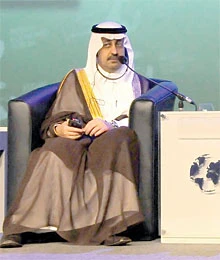
JEDDAH, 27 February 2008 — Prince Bandar ibn Saud ibn Khaled, deputy-managing director of King Faisal Foundation, yesterday called for a close partnership between the government and civil societies to generate, groom and utilize human capital to bring a qualitative change in society.
Speaking at the Jeddah Economic Forum, Bandar ibn Saud said, “For all round progress and growth, optimum utilization of human capital is a must. For that, first, we need to focus on the level of education, which is the engine of human capital mobilization. The government can’t do everything, so the partnership with civil societies is needed to take it further.”
He said that there always remains a gap between the government on the one side and the market on the other. “Non-profit organizations can effectively fill the gap between the public sector and the private sector, and play their potential role in promoting human capital and consequently giving a boost to social economy,” Bandar ibn Saud said. He said that 30 years ago in a village called Al-Habala, people used to live in caves in a mountain and used a rope to come down and go up. “Faisal Foundation took up the village in 1979 and developed it into a model village of Saudi Arabia with all facilities. Now it has got 200 students, which includes 65 girls who are getting modern education. A few of its inhabitants are professors and teachers now, and trying to train the next generation,” he said.
“Human capital development means qualitative search to enhance an individual’s knowledge, skill and innovation. What has happened in Habala is I think the real human capital development,” he said.
He mentioned another similar project taken up by Faisal Society in the village of Al-Heraida in the Asir region.
Effat College, a private women college in Jeddah, runs under the umbrella of the foundation, which also opened Sultan College in Abha and Jeddah and the King Faisal University to name a few. Recently Microsoft has signed an agreement with the foundation to improve facilities at these institutions, said Bandar ibn Saud, who is also chairman of the executive committee of the board of trustees of Alfaisal University.
“We are trying to develop our own system because we want everything to be our own. But at the same time we feel proud in cooperating with others and so would like to forge alliances with global partners to make Saudis competitive where ever they go,” Bandar ibn Saud said.
The government is also striving to utilize the skills and expertise of our youth, he said, adding that the government is also developing human capital to its optimum and in order to provide the youth with jobs, seven economic cities are being built.
Responding to a question from Nasrin Alireza, Bandar said that he agrees with her, “We should have the choice to teach our students where ever we want and also to chose their curriculum. The choice should not be restricted to Saudi curriculum only.” Later, during a panel discussion, panelists also emphasized the role of developing skilled and knowledgeable human capital.
Dr. Mona Mouurshid said that there was an urgent need to improve our education standard to make it compatible globally. “We need to have a proper recruitment policy to hire teachers, because they are the tool of bringing change to society. Recruitment should be done professionally to bring professionalism to teaching,” she said.
“In Korea to get a teaching job you have to be among the five best of the college, in Singapore you have to be among the best 10, but in our system if you are the best from the lower order you can become a teacher. This has to be changed if we want to capitalize on our human capital,” Dr. Mona said.
Ghazi Binzagr stressed the need to involve human element to teaching and learning. Dr. Soliman Abdel Moniem, secretary-general of Arab Thought Foundation, underscored his organization’s efforts to promote Arab culture.