
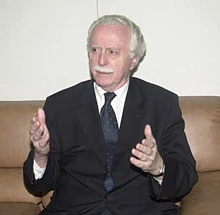
PARIS, 4 March 2008 — “We saw this coming 20 years ago, long before 9/11!” Professor Francis Lamand sits in his Paris office, his face animated with passion and colored by a little anger. “
My organization has been working on building a constructive dialogue between Islam and the West for decades now.” Professor Lamand is the president of Islam and the West, a non-profit organization based in Paris. Once part of Islam et Occident à l’International, an international foundation founded in 1977 in Geneva, the French affiliate headed by Professor Lamand decided to go it alone when the international organization ceased to exist in 1996.
Islam and the West states its aim as building a better understanding between the Islamic and the Western world.
“We work on three levels,” Professor Lamand tells me, “the social, the cultural, and the economic. We aim to build concrete projects in each of these fields”.
He sees his role as that of a mediator between two worlds, a catalyst for bringing people together. What Professor Lamand is keen to achieve is genuine, concrete, constructive dialogue between the Islamic world and the West. What he deplores is the “juxtaposition of monologues” which currently passes for dialogue on the international stage. Lamand is an international lawyer who served as a French diplomat in the Gulf from 1970-1975. For a while he taught comparative law at the University of Kuwait. It was this exposure to Sharia that made him acutely aware of the extent to which Islam is misunderstood in the West. Faced by his own misconceptions, he became determined to work towards deconstructing the myths that exist about Islam.
What he has found is that when people think of Islamic law, they think of a legal system that is alien and different. Whereas in real terms there are many points of convergence between Islamic law and Western law. The problem, he tells me, is that people in the West do not want to hear about the positive aspects of Islam.
What we read in the press, what we see on television, even the history taught in schools is geared towards giving Islam a negative slant. So how do you counter this? I ask him. “By concrete partnerships”. Again and again he returns to the idea of needing to build joint projects rather than just exchanging views, the need to work together rather than simply holding endless talking shops.
Why for example, he asks me, are European law students not taught about Sharia? Comparing legal systems is an example of a tangible way to open dialogue. It builds knowledge and moves discourse away from stereotypes towards genuine understanding.
He has in fact just written a forward to a new book published simultaneously in French and Arabic by Hashem Mahdi — a Précis of Muslim Personal Law — which codifies in simple, unambiguous language the rights of individuals in Islam.
It this kind of bridge-building work which excites Professor Lamand, a real and useful way to bring about a convergence of views.
Professor Lamand’s next big project is an international conference this spring in Brussels, which he says will bring together keynote speakers from all corners of the Muslim world, as well as key figures from Europe and the US.
The conference agenda is split into three sessions. The opening session deals with the search for common ground. Here discussion will focus on identifying areas of convergence, from the joint inheritance of Abrahamic foundations to shared societal values.
The second session will consider the impact of recent events on relations between Islam and the West. It will essentially identify the fault lines between East and West. Questions to be addressed include: What is the media’s impact on Islamophobia? Is Islam a victim or a vector of terror? This session will also consider the roots of the alleged clash of civilizations as well as the roots of so-called “Islamic” terrorism. The final session will focus on building bridges between Islam and the West.
It has been a full ten years since the last conference organized by Islam and the West. How have relations changed between Islam and the Western world in that decade?
Professor Lamand waves off the notion of a clash of civilizations. He sees it as a purely political phrase, a convenient myth brandished to achieve neocon aims. He believes Islamic values sit perfectly well with Western values but that this is an unwelcome view in today’s political climate.
And what about the rise of the extreme right in Europe? He waves that off too. They’ve had their day.
In France for instance, Le Pen is finished he tells me. People are tired of extremist discourse. It no longer shocks the way it used to.
What is more there is now a popular disaffection for that kind of language, people simply do not want to hear passionate and angry diatribes, they turn away from it.
And yet the overwhelming feeling is one of pessimism. Professor Lamand worries that the worst is yet to come. We must not be lulled into a false sense of security.
In French we have a saying he tells me: “an oncoming train can hide another. The bigger danger may be just around the corner.”