
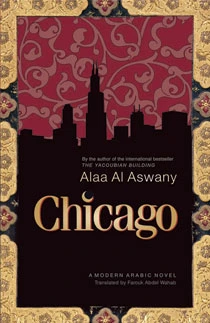
THE eagerly awaited translation of “Chicago” by Alaa Al-Aswany, famous for his bestselling novel, “The Yacoubian Building,” has just been released. The setting of Chicago is far removed from the picturesque downtown Cairo of “The Yacoubian Building.” Readers looking for an authentic Egyptian atmosphere will be disappointed. The novel, as the title indicates, draws on the author’s two-year stay in Chicago as a student in the late 1980s. The novel follows the lives of several Egyptian graduate students and college professors studying and teaching at the University of Illinois. “Chicago” draws the reader into the web of Egyptians’ interactions with the Western way of life. It also attempts to explain how American culture influences their way of thinking and transforms not only their lifestyles but also their personalities. “Chicago is where all the American contradictions play out. All the ethnic groups are there, the rich, the poor. Everything. It somehow comes together,” says Alaa Al-Aswany.
The novel features a strong cast of characters such as Professor Ra’fat Thabit who has lived in the US for decades. He refuses to acknowledge his Egyptian roots and lives like an American with his wife and daughter: “This absolute pride in everything American coupled with contempt for everything Egyptian explains everything he does,” writes Al-Aswany. His daughter not only turns out to be a crack addict but she also elopes with her boyfriend.
Professor Muhammad Salah, Thabit’s colleague, has also been living for 30 years in America. He becomes increasingly frustrated and dissatisfied with himself and ends up realizing that he has wasted his whole life by immigrating to the US.
Tariq Haseeb is a brilliant honors student who seduces the veiled naive student Shaimaa. Nagy Abdel Samad, another Egyptian graduate student and a committed leftist activist, finds refuge in the US but persists in setting up an opposition movement. Framed by Ahmed Danana, a graduate student who is in fact an undercover agent working for the Egyptian government, Abdel Samad is eventually arrested by the FBI, accused of conspiring to kill innocent Americans.
Ahmed Danana is the most despicable character in the novel. As an informant cooperating with the Egyptian Embassy, he spies on all Egyptians studying or working in the US. He passes as a devout Muslim yet he is willing to trade his wife’s honor in order to please an official.
While some readers believe that these characters are clichés, others, on the contrary, feel they can relate to all the characters developed in the novel because they exist within the Egyptian community in the US. Stereotypes found in the novel “Chicago” often pale in comparison to those in real life.
Before it was published, “Chicago” was first serialized in Arabic in an Egyptian newspaper. According to Al-Aswany, it was viewed favorably by 90% of the readers. When the book was released in Arabic, it sold 15,000 copies in 20 days and it has gone through 10 editions in less than a year.
A practicing dentist, Alaa Al-Aswany was a successful writer before “The Yacoubian Building” made him famous. Although it remained the number one bestseller in the Arab world for five years, Al-Aswany acknowledges that he cannot make a living from writing in Egypt. But “Dentistry is good for writing. People come and go. You can observe them closely,“ he says.
He says his love for literature came from his father, another famous novelist. He sees literature as “One of the most beautiful and noble arts of humanity. One of the big lessons of literature is not to judge people, but to try to understand and forgive them,“ he says.
Alaa Al-Aswany is a member of the “Kifaya” (Enough) Movement and is a long time opponent of the Egyptian regime. He feels that his surprising success highlights the true spirit of Egypt and acknowledges that he counts on his country’s tolerance and his readers and so far “They have not let me down,” he concludes.