
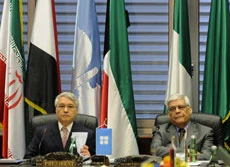
VIENNA, 6 March 2008 — OPEC maintained its output level yesterday, ignoring US pleas to pump more crude to help rein in soaring oil prices, which struck record highs above 104 dollars per barrel.
OPEC, which produces 40 percent of the world’s oil, said it was supplying consumers with enough crude and insisted it was not responsible for rocketing prices.
The price of New York oil crossed $104 for the first time yesterday on sliding US crude inventories, a plunging dollar and after the Organization of Petroleum Exporting Countries decided to keep its daily production target at 29.67 million barrels. New York’s main oil contract, light sweet crude for delivery in April, leapt $4.78 to $104.30 per barrel at 1705 GMT.
OPEC yesterday blamed the high cost of crude on speculative buying as investors sought a haven amid a weak dollar and high inflation. “The conference observed that the market is well-supplied, with current commercial oil stocks standing above their five-year average,” OPEC said in a final communique following its output policy meeting in Vienna.
“The Conference further noted, with concern, that the current price environment does not reflect market fundamentals” (of real supply and demand).
US President George W. Bush, whose country is the world’s biggest energy consumer, had said on Tuesday that it would be a “mistake” for OPEC not to hike production. “I think it’s a mistake to have your biggest customer economy slow down, or your biggest customers’ economy slowing down, as a result of high energy prices,” Bush said Tuesday as he met with Jordan’s King Abdallah.
Saudi Arabia’s Oil Minister Ali Al-Naimi, OPEC’s most influential voice, said in remarks published yesterday he saw no need to change production because oil market fundamentals were steady and “healthy.” He blamed record high prices on “tremendous speculation.”
OPEC is producing 32 million barrels a day, including output from Iraq which does not form part of the cartel’s official output quota, according to the cartel’s president, Algerian Oil Minister Chakib Khelil.
Energy-hungry India has also expressed concern over the rising price of crude, saying yesterday that current rates were “very disturbing.” “The $100 a barrel price is here to stay,” R.S. Sharma, chairman and managing director of state-run Oil and Natural Gas Corporation (ONGC), India’s biggest oil company, told a conference in New Delhi before crude hit a new high.
“If we look at statements from OPEC countries, when they say that $90 a barrel should be considered the floor price, it is a matter of great concern and anxiety.
“It is very disturbing for oil consuming countries,” he added.
OPEC said it would not follow up Wednesday’s meeting with an extraordinary ministerial gathering.
OPEC Secretary General Abdullah Al-Badri had earlier told reporters the organization would hold an extraordinary session before its next scheduled gathering in September, amid global economic turbulence sparked by the collapse of the US subprime home loan market.
Looking to maximize earnings from rocketing oil prices, hard-line OPEC members Algeria, Iran and Venezuela had called for a cut in production at yesterday’s meeting.
Demand for heating fuel was set to fall during the second quarter as warmer temperatures come to Europe and the United States after the winter.
OPEC fears that a hike in output would send oil prices tumbling, thus reducing the income of its 13 members, which include the world’s biggest crude producer Saudi Arabia.
At an extraordinary OPEC meeting on February 1 in Vienna - called amid fears of a global economic slowdown - the cartel agreed to maintain its current output quota, ignoring previous pleas from Bush to increase production.
OPEC comprises Algeria, Angola, Ecuador, Indonesia, Iran, Iraq, Kuwait, Libya, Nigeria, Qatar, Saudi Arabia, the United Arab Emirates and Venezuela.