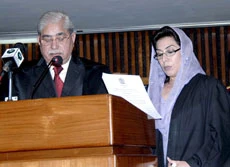
ISLAMABAD, 20 March 2008 — Pakistan’s Parliament yesterday elected its first woman speaker in the country’s 60-year history, a loyalist from the party of assassinated former Prime Minister Benazir Bhutto.
Fahmida Mirza, 52, got 249 votes while the opposition candidate for the speaker, Israr Khan, jointly fielded by Pakistan Muslim League (Q) and the Muttaheda Qaumi Movement could poll 70 votes.
Lawmakers pounded their desks in approval as the purple-veiled former medical doctor was announced the winner from the 342-seat lower house of Parliament or National Assembly.
“Fahmida Mirza is declared to have been elected as the speaker of the National Assembly,” outgoing speaker Amir Hussain announced after a daylong vote before handing over the speaker’s chair.
Fahmida then took the oath as the first woman to hold the position of speaker.
Her husband Dr. Zulfikar Mirza was charged with corruption by the Accountability Bureau run by former Prime Minister Nawaz Sharif’s close aide Saifur Rahman during Sharif’s tenure as prime minister.
“This is my third tenure in the National Assembly and I believe it is time that we all work together to address the challenges facing the country,” Fahmida told reporters before the session. “I am sure that we will be able to face these challenges with the support of parliamentarians, our people and Pakistani media,” Fahmida said.
“The election of Fahmida Mirza as speaker will be a big step toward the empowerment of women in Pakistan,” Shah Mahmood Qureshi, a central PPP leader, told reporters. Fahmida, who has vowed to run Parliament “like a home,” later got down to business, inviting Chaudhry Pervez Elahi, the new opposition leader, to speak first.
Pervez, whose party is President Pervez Musharraf’s main political prop, pledged his “full cooperation” in the assembly.
However, he appeared to urge the incoming government to drop plans to strip Musharraf of some of his remaining powers, which include the right to dissolve Parliament and the government.
“I hope that everyone has learned a lot and the clash of institutions to grab more powers will be avoided, and that institutions of state will continue to function within the sphere of their authority and move ahead,” Pervez said.
“This is a big test and I hope that with the honor that Allah has bestowed upon you, you will be able to live up to expectations,” said Pervez.
Faisal Karim Kundi of the PPP was elected deputy speaker with 246 votes against 68 votes bagged by Khushbakht Shujaat, the opposition candidate for deputy speaker’s post.
Meanwhile, Benazir’s teenage son Bilawal Bhutto Zardari returned to Pakistan yesterday to announce the party’s nomination for the post of prime minister, a party spokesman said.
The 19-year-old student at Britain’s Oxford University was named Benazir’s heir apparent after she was killed in a Dec. 27 attack. Until he completes his studies, his father Asif Ali Zardari has taken the PPP’s reins. “Bilawal will announce the name of the prime minister,” party spokesman Farhatullah Babar told AFP.
“The name of the prime minister will be announced when the (new Parliament session) is reconvened for the election of the prime minister,” which is expected next week, Babar said. Party insiders say the current front-runner for the position is Yousuf Raza Gilani, who was parliamentary speaker during Benazir’s government from 1993-1996.
Makhdoom Amin Fahim, the parliamentary leader of Benazir’s party, said Pakistan is “back on the path of democracy at the end of dictatorship.” Fahim praised Zardari for nominating Fahmida as speaker. “Asif Ali Zardari is a friend of friends. Once he makes any promise, he honors it,” Fahim said.
— With input from agencies