
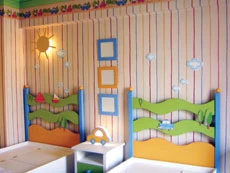
LAYLA Al-Zayat’s interest in children’s furniture began 20 years ago when she designed her children’s bedroom. The challenge was to maximize the use of space in a small room: “I had to fit into a limited area two children as comfortably as possible. At that time, I was convinced that the more empty space there was in a bedroom, the better for children.”
Cairo-based Layla, an architect by profession and founder of BONBON Designers of Children’s Rooms, is quick to point out that many parents are not aware of how a bedroom is conceived. Parents often wrongly think that children’s furniture is merely all that is needed.
“I always plan a bedroom with its furniture but I first organize the space. According to the size and shape of the room, I choose the best place for the child to sleep and to study. Then I think of the furniture in terms of its functional and practical use. The decorative aspect of the room always comes last.“
Al-Zayat’s constant idea of maximizing the use of space led her at an early stage to make multitasking children’s furniture or flexible furniture — furniture that can serve several purposes and that can also be adapted to different uses as children grow up. For many decades, parents and the makers of children’s furniture saw it as throwaway. Al-Zayat, on the contrary, has always categorically refused the idea of discarding children’s furniture.
She admits that everyday objects are becoming less and less permanent. There was a time when people kept the same house phone for many years; nowadays, people are constantly changing their cell-phones. But she feels it is a great waste of money to use children’s furniture for only a few years: “I plan a child’s bedroom from the day he is born to the age of 17. All the furniture I design can be reused and adapted to a child’s growing needs. A bedroom should definitely be functional but it should also have a playful atmosphere.”
Her flagship handmade crib converts into a small bed where a child can sleep until the age of three; it can later be reused as a sofa by taking away one of the sides of the bed and fitting it with cushions.
Al-Zayat blends the functional aspects of furniture with its design and emotional content to create unique handmade children’s furniture which are made to last. Her forte is that she takes into consideration a child’s needs. In all the bedrooms she has created, everything can be reached by the child without any help from the parents: “When a child can switch on the light, take out his clothes, shoes and toys by himself without his mother’s help, he learns early to be independent.” She also pays great attention to details, especially where interior design is concerned.
The decorative aspect of the bedroom is closely linked to the chosen theme: “Whenever possible, I try to work with the children. They are better suited to select the theme for their own bedrooms. And I also have to know if they have special requirements. One child wanted parallel bars to do his gym exercises. Once I did a room for a young boy and I learned from his mother that he was very unhappy with what I had done. Something was upsetting him but we did not know what. I decided to talk to him and he told me that the playing space I had provided for him was too open. He just wanted me to hang up some curtains so he could isolate himself. It was a small detail but it was enough to make him feel miserable. Some children even ask me to make a secret drawer for them where they can hide their personal belongings. I always pay great attention to a child’s needs; after all he will spend so much time sleeping, studying and playing in a single room and it is important for a child to feel comfortable and happy in his bedroom.”
Al-Zayat’s approach to design is based “on a philosophy.” She admits that she has never been concerned by the commercial aspect of the business but she has always set her goals on creating a flawless product: “Whenever we find one small mistake, we start all over again. Most of our customers are unaware of how much work is involved in creating a beautiful bedroom but once they see it, they love it.”