JEDDAH, 23 March 2008 — A new technical guidebook for renovating Jeddah’s historic center, known as Balad, is currently being prepared with the help of French consultants, according to a municipality official.
“The new guidebook would create major shift in the way we deal with the historical area regarding renovation and maintenance,” said Sami Nawwar, head of Tourism and Culture Department at the Jeddah Municipality.
The book, which is due to be completed in six months, would be provided for free to all contractors working on the historical area’s renovation projects. Owners of all buildings in the area have been ordered to renovate their properties without fail.
A committee was recently formed comprising the regional governorate, the municipality and the Civil Defense to identify the historical structures in all three districts of Jeddah’s city center. The committee has informed the owners of structures that are in poor condition to refer to the municipality’s Historical Area Department to finalize the procedures for renovation, he said.
He said that the group of French experts would also hold training courses for the municipality’s engineers on structure development and treatment of limestone, which is one of the main building materials used in historical structures in Balad.
The courses also include scientific methods in restoring the wooden latticework that goes over windows (called “roshana”) that characterize old pre-airconditioning buildings in Jeddah and elsewhere in the coastal regions of the Arab world. The guidebook will also instruct on regulations for size and positioning of signs in the historic center.
“Time is a factor, as the situation of many structures in the area requires fast action,” Patrice Moru, head of the French consultancy team. He said that the guidebook puts the experience of traditional builders into consideration, as it would be easy to follow by local craftsmen who are hired to restore the buildings.
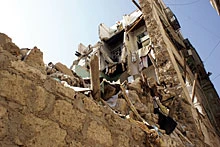
During the last few years, several structures in the historical area have collapsed while some have been completely destroyed by fire.
Last year, Custodian of the Two Holy Mosques King Abdullah has urged municipal authorities to prepare a comprehensive study on how to develop Jeddah’s Balad and pledged to finance future initiatives.
Following the king’s support, municipality officials announced that they have formulated 42 development projects for the city’s historical area to be completed over the next 10 years.
Jeddah’s Balad has been short listed for consideration as a UNESCO World Heritage site. However, to qualify for such status, original buildings must be preserved. Tearing down original structures and constructing replicas — as was done with the segments of the old wall that once surrounded the port city — would make Jeddah’s Balad ineligible for the World Heritage status. UNESCO considers replacing original structures with replicas as insufficient for the purposes of historical preservation. The ancient city of Madain Saleh has been the first location in the Kingdom to be officially submitted for UNESCO World Heritage Status. The ancient Nabatean sister city to Petra in Jordan, located about 300 km north of Madinah, could become the Kingdom’s first UNESCO World Heritage site as early as next year.