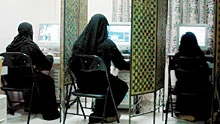
RIYADH, 4 April 2008 — In a country where there are restrictions on unrelated men and women meeting outside without risking the ire of the authorities, it should come as no surprise that the Internet has become a proxy for face-to-face social interaction.
“This makes people live double lives,” said Ahmed Al-Hariri, a sociologist and presenter of social programs on Al-Eqtisadiah TV. “A conservative one outside and a free virtual one inside.”
And this virtual world is not relegated to, or even dominated by, young men.
Fahad Al-Sudairy, an information technology expert and head of MTSCO, an IT company, told Arab News his company estimates that two thirds of Saudi Internet users are women.
“The reason why women are active participants in cyberspace is because they participate less in social space,” he said.
So this perfect-storm scenario — traditional Arab values facing the incursion of social networking technologies — is leading women and girls to use the Internet as a substitute for prohibited social interactions.
The issue took a grim turn earlier this week when Al-Arabiya’s website reported that a man had beaten and fatally shot his daughter when he discovered her chatting online through the popular social networking site Facebook. The incident took place in August and was not reported until an Islamic scholar in the Kingdom referred to the crime in a speech against online social networking.
Dima’s Fashion
“Dima” — the name of her online personae — is a young Saudi woman in her late teens or early 20s who operates a regular online fashion show where she exhibits outfits that would be illegal to wear in public in Saudi Arabia.
She states on her website that she is not interested in immoral trysts or meetings with anyone who contacts her through the site, and she’s careful not to show her face.
Her motive, she says, is simply to reveal what she cannot wear in public.
“I like to show off my beauty, and unlike some ‘webcam girls’ my show doesn’t go too far,” she said.
“I have many stylish clothes, such as mini skirts, that need to be seen by people — and this is what my show is all about.”
Boys, of course, don’t mind. “It’s nice to see how girls look, smile, dress and move,” said a young man in his teens contacted by Arab News, who goes by the online screen name “Zozo of Najd.”
“Watching girls by webcam is much better than throwing my number to a girl that might be ugly!” he said, referring to a common practice by young Saudi men to sneak their phone numbers to girls on the fly. (Slapping a Post-It note quickly on car window was a common technique until Bluetooth made relaying text easier and more discreet.)
The Hunter and the Flirt
Boys seem to often play the role of the “hunter” in online social networking, scouring sites like Facebook, MySpace or Arab-language networking and chat sites, looking for pictures, videos or live Web camera action.
Girls, on the other hand, tend to use the Web to chat with each other, or to flirt with guys with little intention of actually meeting them in person. But in a twist that may be unique to Saudi Arabia, women seem to outnumber men on these social-networking sites, which is likely due to the fewer social options given to them in society.
Young men might leave the computer to drive out to the desert for camping or four-by-four adventures with their friends.
Women, on the other hand, would not be permitted to do so unless they were part of a larger family excursion. In essence, Saudi girls simply have more time to spend online.
A recent study published at an Arabic newspaper in March revealed that 85 percent of girls are using Bluetooth technology “negatively”, and that most text messages sent among young people discuss social taboos.
Both girls and young men prefer to write poems along with their numbers and text each other in public places.
But aside from mobile phone foreplay there’s the webcam. A rash of busts in countries like the US and Britain have shown that Web cameras and children are a potentially dangerous combination at worst.
“There’s almost nothing a child can do with a Web camera that’s good,” said New York Times reporter Kurt Eichenwald in an interview on the Brian Lehrer radio program last year. Eichenwald wrote a controversial report in 2005 that led to the arrest of dozens of profiteers of Web-based child pornography in the United States.
The reporter says that he closely monitors his own children’s online habits and doesn’t allow them to use Web cameras.
Boys Will Be Boys
Boys interviewed for this story said that finding girls using Web cameras is one of the few ways for them to interact with them.
Social restrictions on mingling between young men and women make even casual interactions difficult. And despite Saudi Arabia’s Internet blocking system — which filters out pornographic sties — the practice of Saudis flirting and even sending prurient images to each other is common.
Hatoon Al-Fassi, a columnist and a professor of women’s history at King Saud University, said that the misuse of technology comes as a natural consequence of the controls that prevent girls and boys from simple rights.
“Boys are prevented from entering many shopping centers and are prejudged by mall security,” she cited as an example.
“Girls are not given any options to choose how they appear publicly and most of the times are ordered to cover their faces.”
Sociologist Al-Hariri agrees. “We still adopt these old social controls regardless of whether or not they fit with the modern era,” he said.
“We are in need of developing social rules in a way that can play an effective role in education and instilling self-control. The more repressive restrictions we impose the more backlash will be created, especially among young people who are already rebelling against their traditions and customs.”
Before reacting angrily, or in the case of the Riyadh father, murderously, to online social interactions, Al-Hariri says society should examine the reasons why these interactions are taking place.
“Before we all lash out at technology and blame it for corrupting our values, we should consider these questions: Have we educated our children properly, or do we just repress them in our aim to have an ideal society?
Also we should ask ourselves if we really understand what’s going on with our young people.”
A Warning to the Ladies
Meanwhile, Reem Abu Eid, a Riyadh-based Egyptian author, and Saudi university student Aisha Al Hazami have launched an online campaign called “Ana Bashar” (“I’m a Human Being”) with the aim of teaching young women to be careful on how they manage their online reputations.
A girl’s photograph, even something as seemingly innocuous as a passport or vacation photo, getting distributed via mobile phones or posted online, can lead to family defamation issues that can have serious social repercussions — especially in smaller communities. (This is one of the main reasons why taking photographs in public places is cautioned against in Saudi Arabia.)
As such, Abu Eid and Al-Hazami want to give a head’s up to up-and-coming ladies to be very careful of what they post online or send to other people via Bluetooth or e-mail.
“Many girls have found their pictures, videos, and recorded messages spreading wildly through the Internet and other technology outlets and can’t do anything about it because the law is unable to reach the offender.
The campaign has a website to collect signatures of people who pledge to guard against the dissemination of digital media that could potentially harm a woman’s reputation.
The campaign also calls for creating a codified defamation law to send a message to those who seek to destroy a woman’s reputation and family life through the World Wide Web.