
Biased? Yes. So, having got that out of the way, let us add the reason. Malaysia is a polar contrast in every way possible to the magnificently minimalist sand steppe of Saudi Arabia. Vibrantly green, heaving with blooms, birds and busy people and exuding an energy in the urban areas that verges on the manic, it is inexpensive in most of the areas that matter, even by Saudi standards. And the whole place is immaculately clean. Even hundreds of kilometers away from urban areas, there is rarely, if ever, a speck of trash to offend the eye.
Traveling in Malaysia is, as those addicted to the round ball game might say, “a game of two halves,” urban and rural. However, as far as getting there is concerned there is only one way. Malaysia and Singapore really start to work their magic the moment you step on to a Singapore Airlines jet; impossibly elegant stewardesses seem actually to enjoy serving you and attending to their duties. Formalities at the other end of the journey are, though thorough, swift and efficient.
Island and rural Malaysia is a photographer’s dream. Palm trees on beaches actually do lean over azure seas in that enticing way travel brochures show them. There are houses on stilts — indeed, the Aryani Resort in the province of Terengganu, 50 minutes flying from Kuala Lumpur, will rent you one perfectly restored to original condition right down to the gaps in the floorboards which allow air to circulate.
I digress awhile once more at this point. Ever said “I want to get away from it all?” Try the Aryani but be warned; you really are “away from it all!” It lies a kilometer down a rough track and behind moss-covered stonewalls that look decayed. Look again; they are perfectly built, just allowed to be mossy. And that gives the clue. Just twenty chalets, designed by the architect who was responsible for the striking and traditionally styled National Museum of Malaysia, rest in a beautifully tended piece of jungle next to an empty beach that stretches scores of kilometers in each direction. The bonus is that the architect’s wife, To’ Puan Norilah Salleh, also passionate about tradition, runs the place. Believe me, soaking in a Jacuzzi in your own private roofless bathroom or at the hotel spa — also open-air — and following that up with a massage in a wooden Malay style wooden-stilted orchid-filled treatment room is as close to paradise as anyone deserves to get. The food? Magnificent — and a real bonus is that other guests positively avoid you; the limit of intimacy is a courteously nodded head. No discos, organized ‘family fun,’ wi-fi or beach parties. Just quiet discreet wrap-around service. Great!
Malaysia is renowned for its islands; there are thousands. Some are reachable by swimming. The ones with resorts tend to be a short ferry ride from the mainland. The Laguna Island resort off Redang Island is one such, an hour off shore, set among those sugarloaf tree-covered islands that are reminiscent of a Bond movie.
The ferry ride is largely uneventful; however the jetty area is a microcosm of coastal life. Side by side with the ferry-boats, simple fishing boats jostle for beach space. Tucked away in the mangroves hard by are used and rotting wooden boats, tangles of nets and the detritus of a working fishing quay, but still, no litter. Mind you, if you walk unwarily towards the photo opportunity these represent, watch out for he spider webs at head height; their occupants are big.
The Laguna Resort, set on a film-set of a white sandy bay and surrounded by jungle, is a benchmark for Malaysian resort hotels. However the clientele is very different from the voluntary isolates of the Aryuna. Catering largely to Chinese and Indian top end package tourists, the hotel is — as usual in the country — immaculate and perfectly maintained. Far from ‘away from it all,’ you will be in the thick of it at meal times; food is plentiful and wholesome. However, my resolution to try everything once fell at the last fence when contemplating the “fish-heads in fluid” for breakfast... I swear one winked. No matter, I left them to the Chinese guests who consumed them with great gusto; there were half a dozen identifiable alternatives. Facing the east and ten meters from the beach, the open sided dining area is a favorite at sunrise — which is generally a magnificent affair with low clouds scattering the rays of the rising sun into shafts of pink light.
Oddly enough, during the day the guests seemed to evaporate; the beach was practically deserted, the diving center all mine, the marine conservation park and all the hotel facilities seemed unused. This happened every day; in effect, the hotel was oxymoronically empty but full. Weird, but wonderful.
The administrative head of the area, Kuala Terengganu is a largish town with some remarkable sights to please the cultural tourist. Three vie for top billing; the Crystal Mosque, the National Museum and the Islamic theme park on Wan Man island.
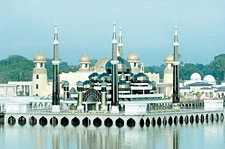
The Crystal Mosque is a multi domed and minaret-ed structure built at the confluence of two rivers. It is an amazing building; every visible surface of the domes and minarets is covered in reflective glass panels. It could easily have been gaudy, but the sheer scale and sharpness of the design saves it from that fate.
The National Museum, only a kilometer away, is one of the most pleasant museums I have ever visited. Built in a style of the Malay wooden houses that dot the countryside, it took 14 years to build and is set in positively lush grounds by the river. Large external exhibits — boats for example — compete with the interior displays of Malay culture. A complete and very enriching day out on its own.
Probably most remarkable in its innovation is the Islamic theme park, scheduled for completion by the end of May this year. Frankly, every non-Muslim should visit it. In it are large-scale models of every famous mosque in the world and a few buildings designed by Muslims that are not mosques — the Taj Mahal for example. The scaled down replicas are remarkable for their detail and craftsmanship. For example, I discovered that the faience tiling on the model of the Dome of the Rock is just that; tiles, minute replicas of the original and not paint. I shall never think of the “Dark Ages” as dark again; they may have been in the west, but Islamic culture, especially architecture, was at its zenith.
On a less grand scale but intriguing just the same, was the boatyard tucked away in a quiet residential area on nearby Duyong Island. Builders construct boats — most along traditional lines — from local teak. Just to indicate how skilled these laid back builders are, it came as a surprise to learn that they have produced one America’s Cup entrant in their time and many modern craft for owners in the Gulf. The somewhat rudimentary appearance of the place belies the talent therein.
The attraction of the less urbanized and rural areas is that while quiet and extremely pleasant to be in, there are always surprises to be found in the most unlikely places. A fish sausage manufacturer for example who is in full production in a rather cavalier wood and palm frond shelter near the ferry — that fish just has to be fresh — and is willing to fry you a sample on the spot.
The glue that holds the rich and varied fabric of Malaysia together is the warm acceptance of the people. Without exception, the welcome was genuine, even to the point of being invited to join in as a guest at two weddings going on in the national mosque, of which more later.
Aryani Resort: www.thearyani.com
Laguna Island Resort Redang:
www.lagunaredang.com.my