
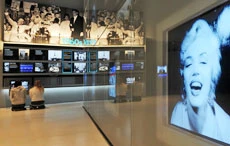
WASHINGTON, 12 April 2008 — The Newseum reopens this week, and it is already being called one of the most technologically advanced museums in the world.
One is impressed even before entering the building: Outside is a 74-foot-high, 50 ton Tennessee marble table on the front façade of the Newseum etched with the words of the First Amendment, written 217 years ago: Congress shall make no law respecting an establishment of religion, or prohibiting the free exercise thereof; or abridging the freedom of speech, or of the press; or the right of the people peaceable to assemble, and to petition the Government for a redress of grievances.
Dozens of newspapers front pages are on display out on the street. It is quite a sight, and definitely an attention-getter for pedestrians.
Inside the museum is both informative and fun. Whether one is a news junkie, a history hunter or interested in digital interaction, all is available here. And, in no time at all, one’s enthusiasm for the media — is contagious.
Six years ago the original, smaller Newseum across the Potomac River in Arlington, Va., closed.
The new Museum opens to the public this Friday, April 11, in a $450 million, 643,000 square-foot 7-story building, located next to the Canadian Embassy and across the street National Gallery of Art. The building’s prime location offers a breathtaking view of the Capitol from its sixth-floor balcony — perhaps the best in town.
The big question is: Will visitors want to choke up the $20 dollar entry fee? Journalists present at the Newseum’s press preview on Tuesday were not so sure.
Yes, Madame Tussauds Wax Museum here in Washington costs $21.15, and the nearby International Spy Museum charges $18. But the fact remains that the museums on the National Mall are free and practically just across the street from the Newseum.
Competing with the Newseum will be the Air and Space Museum, the National History Museum and the National Archives and the National Gallery of Art; it’s also close to Ford’s Theatre, where President Abraham Lincoln was shot.
Then there’s the hook — what will pull tourists in to visit it?
This is what one reporter had in mind during a press briefing Tuesday when he asked if the museum was a tribute to a “dying industry.” Traditional news organizations are struggling to survive while coping with journalism scandals, being bought up by huge corporations, falling advertising revenues, and limited resources that have closed down many overseas bureaus that are forcing more and more news organizations to rely on news agencies for their news.
“We are not here to chronicle that, but rather the Newseum is about news and the stories of our lives — we are here to chronicle the delivery of the news system,” said the Newseum’s CEO, Charles Overby.
And chronicle they do — with the museum’s seven levels and 14 galleries, there’s something always going on. Additionally, there are 15 theatres, two television studios (ABC’s This Week With George Stephanopoulos will broadcast every Sunday from one), and a hand’s-on master control center open for learning.
There are also 48 interactive computer kiosks that allow one to immerse themselves in the news experience, as a reporter, photographer, or even a blogger.
Within the building are thousands of newspapers to read, hundreds of hours of news broadcasts to watch, and hundreds of Pulitzer Prizewinning photos to examine. All told, there are more than 6,000 news artifacts, ranging from a newspaper’s first publication in 1545 to the door from the Watergate Hotel room, which led to the eventually downfall of President Nixon.
The Newseum also offers the first permanent exhibit devoted to the terrorist attacks of 9/11. There is also a memorial to more than the 1,700 journalists from around the world who have died on the job since the 1830s.
Unfortunately, the Newseum’s planners did not make any accommodations for non-English speakers. For example, there are no headsets available in various languages for international guests to use in the museum. This is a huge oversight — especially as those who have the money in Washington these days are tourists from overseas.
Fortunately there is a section devoted to international journalism, with a wall-size map comparing press freedoms and newspapers from around the world.
This reporter is happy to indulge in a bit of congratulatory praise for Arab News, as it is one of only two newspapers listed on the interactive news site for media in Saudi Arabia.
The site first lists Al-Jazirah, which it says opened in 1972, followed by Arab News, which it cites as opening in 1975. Quoting the BBC, it says Arab News “likes to see itself as breaking cultural barriers and unifying Arabs and non-Arabs alike in responding to their need for information. The newspaper contains reports from Europe, America, India, Pakistan and Middle East countries.”
It’s certainly high praise if a newspaper is singled out at the Newseum.
One of the most popular sites, it’s easy to predict, will be the Interactive Newsroom, which allows one to become a newspaper reporter or a photographer covering breaking news on a tight deadline. One can even file stories or photos and get feedback.
Another predictably fun site, for an additional $8 dollar fee, allows a visitor to stand before a camera and pretend to be an on-air reporter — teleprompter and all. Grab a microphone and take a stand-up shot in the location of your choice: in front of the White House, the Capitol or the Supreme Court.
Adults can devise their own script, and is allowed two practice runs, with a countdown of 13 seconds before going “on air.” Children are given a script to read, and the teleprompter will run more slowly for them, too, than for adults.
Visitors then receive a souvenir photo of their “on air” experience, and can download their TV performances from a Newseum site the following day, which allows them to share the fun with family and friends.
Another site not to miss is the Ethics Table, where players compete by answering questions about the “right” thing to do as a reporter, and completing their team’s newspaper page. Using motion-tracking technology, players select questions from avatars that appear on the table. Each correct answer fills in a blank on the team’s page.
One of the most popular events being praised by young, aspiring reporters is the Annenberg Theater, which — through the use of special eyeglasses — offers a 4D, 13-minute presentation that is both fun and information. Don’t forget to duck and mind your legs in this theatre. And yes, all the movies are free — all 100 of them within the Newseum.
Planning Your Visit
— The Newseum is located on Pennsylvania Avenue and Sixth Street N.W. in Washington, D.C.
— It is open from 9 a.m. to 5 p.m. daily.
— Admission is $13 for ages 7-12, and $20 for adults. Seniors (65 and older) are $18, and children younger than 7 get in free.
— Tickets can be purchased at www.newseum.org or by calling 888-639-7386.