
ISLAMABAD, 16 April 2008 — Pakistan’s ruling coalition leaders have failed at their latest meeting to set a timetable to reinstate the judges sacked by President Pervez Musharraf.
The leaders of the three main parties in the coalition government met in Islamabad yesterday. Party officials had forecast the talks would yield a strategy to restore the judges — a move fraught with legal difficulties. But the gathering broke up without any announcement of a breakthrough.
The new government faces a long list of economic problems, including a power crisis that triggered rioting Monday by textile industry workers, as well as the challenge of violent extremism.
It is held together principally by its vow to reduce the powers accumulated by Musharraf, who seized power in a 1999 military coup and only stepped down as army chief last year.
The coalition, however, renewed its pledge yesterday to reinstate the judges who were sacked Musharraf, a minister said after the high-level meeting.
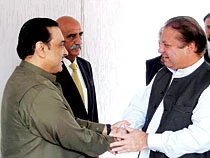
Asif Zardari, the widower of slain opposition leader Benazir Bhutto and head of her Pakistan People’s Party (PPP), met with former Premier Nawaz Sharif of the Pakistan Muslim League-Nawaz (PML-N) in Islamabad.
The two parties after electoral victory pledged at a summit in the mountain resort of Bhurban to restore the chief justice and other judges within 30 days of forming a government.
But yesterday’s meeting between Zardari and Sharif came amid reports of divisions over the issue within the coalition, whose members were at each other’s throats during their periods in government in the 1990s.
The coalition “renewed its commitment to the Bhurban declaration,” Information Minister Sherry Rehman said after the meeting.
“The meeting was one of a series that the coalition intends to have regularly,” said Rehman.
Musharraf sacked the country’s chief justice and dozens of other judges under a state of emergency in November, when it appeared that the Supreme Court was about to overturn his re-election as president the month before.
The judges could in theory challenge Musharraf’s position — and so restoring them with their full powers would spark a major confrontation with the US-backed president.
New Prime Minister Yousaf Raza Gilani, once a key aide to Bhutto, freed Chief Justice Iftikhar Chaudhry from house arrest last month, but analysts say the PPP wants to avoid an overt standoff with Musharraf for now.
However Sharif, the man ousted by Musharraf in 1999, has openly called for the president to quit and made the restoration of Chaudhry a key plank of his policy platform.
Reports say there is even a split about when the government was officially formed, with the PPP saying it was after provincial assemblies were sworn in and Sharif’s party saying it was after the federal Cabinet took office on March 31.
Sharif left Zardari’s residence, where the meeting was held, without speaking to the media. His spokesman, Siddiqul Farooq, told AFP earlier that it would be an “important meeting.
The agenda is restoration of judges and revival of the constitution as it was before the Oct. 12, 1999 coup.”
Raja Pervez Ashraf, minister for water and power, told reporters that the coalition leaders “only took stock of the political situation and nothing extraordinary can be attached with this meeting.”
The meeting also featured the leader of the ethnic Pashtun Awami National Party, officials said. The ANP defeated hard-line religious parties in northwest Pakistan in the elections.

