
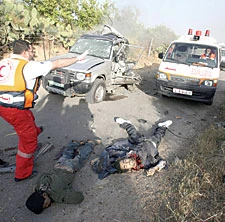
GAZA CITY, 17 April 2008 — The Israeli Army attacked a series of targets throughout the Gaza Strip yesterday, killing at least 19 Palestinians, including children and a Reuters cameraman who was filming Israeli tank movements, medical officials said. Three Israeli soldiers died in separate fighting.
The bloodshed marked a sudden spike in violence in Gaza, which had experienced a relative lull since Israel ended a broad offensive in the area in early March. The Israeli Army often operates in Gaza to prevent Palestinian fighters from firing rockets into southern Israel.
In the deadliest incident, an Israeli helicopter fired four missiles at targets near the Bureij refugee camp in central Gaza. At least 11 Palestinians, including two youths, were killed, said Dr. Moaiya Hassanain of the Palestinian Health Ministry.
The Reuters cameraman, Fadal Shana, was apparently killed along with two bystanders in an airstrike in the same area, according to his colleagues and medics.
Cameramen who rushed to the scene said they saw the Reuters jeep on fire and Shana’s body lying next to the jeep, alongside other casualties. They said Shana’s jeep was marked as “press” and that the cameraman was wearing an identifying flak jacket.
As colleagues rushed toward Shana, another missile was fired, said Wissam Nassar, a photographer with the Maan news agency. “There was an airstrike. We were thrown back, myself and another person.” Dozens of Palestinian journalists went to the hospital, where Shana was pronounced dead, to pay their respects. In all, four journalists have been killed covering the West Bank and Gaza Strip since 1992, according to the Committee to Protect Journalists.
The army confirmed a helicopter had targeted a group of gunmen in Bureij, but had no comment on the cameraman’s death.
Reuters said that Shana, 23, was killed by an explosion while covering the Israeli-Palestinian fighting. Soundman Wafa Abu Mizyed, also in his 20s, escaped unhurt and was treated for shock, the news agency said.
Reuters Editor in Chief David Schlesinger called for an investigation into the incident.
In other violence, Palestinian fighters ambushed an Israeli ground force in northern Gaza, killing three soldiers, the army said.
Israeli defense officials said the soldiers had entered Gaza in pursuit of two Hamas men who planted a bomb near the border. The soldiers were then ambushed by another Hamas force lying in wait, Israeli defense officials said.
The attack occurred near the Nahal Oz terminal used by Israel to pump fuel into Gaza. The fuel supply was cut off last week after two Israeli civilians were killed in a Palestinian attack on the terminal — the only source of fuel for Gaza. Hours after yesterday’s ambush, Israel resumed fuel shipments to Gaza, Israeli and Palestinian officials said.
Mahmoud Khuzandar, deputy director of the Gaza fuel station owners’ association, said a total of eight truckloads of fuel were delivered. He said half was cooking oil, and the other half was diesel fuel for Gaza’s only power plant.
The fuel deliveries were expected to provide minor relief to the Gaza Strip, though they were only a tiny fraction of what the impoverished territory needs, Khuzandar said.
In separate fighting, five Palestinian fighters were killed, Palestinian officials said.
Yesterday’s violence threatened to spark a new wave of fighting between Gaza fighters and the Israeli Army.
Israel’s latest offensive killed more than 120 Palestinians, including dozens of civilians. Since Israel ended the offensive, Egypt has unsuccessfully been trying to mediate a cease-fire.
Hamas seized control of Gaza last June from forces loyal to moderate Palestinian President Mahmoud Abbas. Its continued control of the area, along with the near-daily fighting with Israel, has jeopardized Mideast peace efforts.
Israel hopes to reach a peace agreement with Abbas’ West Bank government by the end of the year. But it says it will not carry out any accord until Abbas regains control of Gaza.
Abbas who arrived in Moscow yesterday for talks with Russia’s leaders, strongly condemned Israel’s escalation of violence in the Gaza Strip.
“President Abbas strongly condemned Israel’s escalation of violence in the Gaza Strip,” said Abbas’ spokesman, Nabil Abu Rudeina.
Abbas “called on the Israeli government to immediately stop aggression and urged all parties to cooperate with efforts to reach a truce and prevent our people from any more suffering if this violence continues.”
Russia is a member of the diplomatic Quartet for Middle East peace, which also comprises the European Union, the United Nations and the United States.
Last week Russian Foreign Minister Sergei Lavrov said the proposed conference would be a useful follow-up to the US-hosted one last November in Annapolis, Maryland.
Although a date for the conference has yet to be set, Abbas said June was being talked about as a possible time period.
Last month, Lavrov visited the Palestinian territories and criticized Israeli settlement activity in the West Bank, calling also for an end to the Jewish state’s “unacceptable” blockade of the Gaza Strip.
Meanwhile, Arab League Secretary-General Amr Moussa said in Vienna yesterday there was no sign of a Palestinian state being created by the end of the year. He blamed Israel for “paralyzing” the peace process. “There haven’t been any concrete results concerning the Annapolis initiative and the promise to create a Palestinian state by the end of 2008,” said Moussa. “It’s almost early May and I can’t see any effort in this direction,” he told a joint press conference with Austrian Foreign Minister Ursula Plassnik in Vienna.
— With input from agencies

