
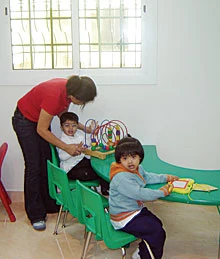
JEDDAH, 18 April 2008 — “I think my calling found me,” said Uzma Hussein, a clinical psychologist and founder of Hope for Exceptional Needs, while speaking to Arab News about how she got the inspiration to open a rehabilitation center in Jeddah.
The first multilingual rehabilitation center of its kind in the city set up 10 years ago, the institution currently has 41 children of 14 different nationalities with another 65 on the waiting list. The center has taught and is currently teaching children with illnesses, such as Down’s syndrome, autism, Attention Deficit Hyperactivity Disorder (ADHD) and cerebral palsy, among others.
According to Hussein, 24 percent of students who come to Hope have with multiple disabilities. The center has both male and female students ranging in age from 10 months to 13 years.
Students are taught behavior modification, special education using Scott Foresman educational materials, an American-style curriculum, life-skills training, vocational skills and information in computing and technology.
In addition, the students also benefit from therapeutic services, such as hydro therapy, speech therapy, art therapy, physiotherapy, occupational therapy and hippotherapy — a type of horse riding therapy done once a week at Open Skies, a therapeutic riding ranch in Jeddah.
“We want our students to be able to work in a profession when they grow up and show Saudi society that they are just as able as any one else to be valued as a person and a citizen despite having special needs,” said Deborah Metwalli, assistant director at Hope as she took Arab News on a tour of the villa, which was under construction and will be more accessible for disabled students.
“You really don’t see kids with special needs in public places here like you do in other countries as they are, quite unfortunately, viewed as a ‘dirty secret’ in this society,” Hussein told Arab News, commenting on the plight of the students with special needs in the Kingdom.
“I have had parents literally ask me to conceal their family names because of the embarrassment they said they would encounter if news got out in society that they had disabled children. Other times, I have had parents arguing in my office about whose fault it is genetically that they have a disabled child. There is not one day that I am not surprised by the social stigma associated with disabled people in Saudi Arabia,” she said.
“We have to change the face of rehabilitation in this country,” reiterated Hussein, adding that there is still a lot to do before the stereotype surrounding the children with special needs in Saudi Arabia is eradicated, but she is ready for the challenge.
However, “challenging situation” is a phrase Hussein has had to grow accustomed to in overcoming many obstacles on the road to establishing a place called Hope. As one of eight post-graduate students chosen to attend a University of Manchester (UK) course to become one of the first Saudis to be trained as Certified Teacher for Education of Developmentally Young (EDY), Hussein’s first experience working with children with special needs was at Tender Loving Care (TLC) in Jeddah where she began training others in EDY.
“While I was working at TLC, I noticed a gap in the available facilities for non-Arabic speaking expatriate children with special needs,” she said.
Initially, Hussein said she had no funds to build the center. Hussein began accepting students to her home on a one-on-one basis in 1997. Two months later in the month of July, she organized a summer camp in two rooms of her apartment with nine children.
“It was at the closing summer camp party that parents approached me and said that their child really enjoyed the summer camp and that I should consider holding studies all year round,” she said. “But without money to back such a project, I had to decline.”
However, the parents said they would pay for the first six months tuition up front in order to help get the center going. “I accepted and rented an apartment across from mine. With my husband’s help in bringing books and supplies, I started with the same nine children from the summer camp,” Hussein said.
Four years later, one of Hussein’s colleagues, Majda Al-Otaibi, from TLC came to visit her center and was impressed enough to offer help to get a license from the Ministry of Social Affairs. She also helped in getting donated furniture and study materials.
After receiving her license without any financial support from the ministry, Hussein managed to rent a villa in Al-Nuzla district of Jeddah in 2002 and hired staff to work with the children. However, she said, salaries are low.
“I really commend the teaching staff that we have at Hope. You can tell they aren’t here for the money, they really care for the students from their heart with a lot of dedication,” she said.
But even with dedication and heart, Hope is constantly in a financial deficit. Hussein says that Hope is currently in debt by SR388,700.
“It costs SR20,000 per year per child, not adding bus fees,” she said. “This is why Hope is currently looking for sponsors to come forward in supporting a student with special needs. I have taken many students whose parents simply can’t afford to send their children to a special school and since they are not permitted by law in Saudi Arabia to join the mainstream schools, many children would simply be left behind emotionally and educationally if they didn’t have our school to turn to.”