
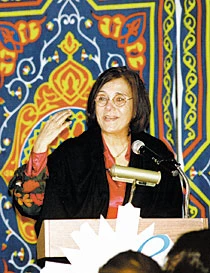
Here's a story to love. It's not quite rags-to-riches, but close enough. This story is about a woman who succeeded in the man's world of Egyptian jewelry design.
Azza Fahmy tells everyone that it all started over 30 years ago with a simple trip to a book fair that changed her life forever. At the time, in the 1960s, she was working as an interior designer and a book illustrator for the Egyptian government.
Then, while browsing through books at the annual Cairo Book Fair, she came across a book on German Medieval jewelry that captivated her. Never before had she seen anything like it.
"I spent my salary on it even though I didn't know a single word in German," she said. "Now I believe in destiny and I know that it changed my life forever. Because of that book, I found my niche in life."
"When I saw this book it gave me direction. It inspired me to attend the Faculty of Applied Arts in Cairo," she told Arab News recently at an event hosted by the Egyptian Embassy and organized by the Washington-based Mosaic Foundation, a non-profit that aims to improve the lives of women and children in the US and the Middle East.
Fahmy was born in the southern governorate of Sohaj, Upper Egypt. She moved to Cairo to study fine arts, but it was her fascination with jewelry design that made her push to become an apprentice to a gold and silversmith jeweler at the historic souk of Cairo's Khan El-Khalili. There, she became the first woman in Egypt permitted to enter into the traditionally male-dominant profession.
"For 15 years, I dressed in overalls and worked at Khan El-Khalili. I watched the master jewelers work - they taught me many secrets of jewelry. Then I'd go home and write about the secrets of these masters. I would also collect jewelry pieces from them."
She said that it was very unusual at the time for women to work there.
"But I managed," she demurred. "My family was not very supportive at the beginning because they could not quite understand what I was doing, but I was very confident about my work."
Fahmy mentored under a man by the name of Hajj Sayyed. Throughout the 70s she produced jewelry she called "primitive". She learned quickly that designing the pieces was the easy part.
"When one designs jewelry, one has to know how to do it," she said. "Not only how to draw it, but even more importantly, how to be able to work with the material."
Her creativity grew with time and effort, and through research, reading and visiting museums. Eventually, she said her aspiratiosn grew beyond what her mentor could facilitate.
"I felt crippled because I couldn't translate my designs into actual jewelry, yet I could not afford to go and further my studies abroad," she said.
Then, with a strange twist of luck in the 70s, she was given the opportunity to study jewelry design at the London School of Polytechnic.
"I returned back to Cairo with a new sense of jewelry," she said. "Everything inspired me, and still does. Palm trees, birds, flowers, and the motifs in a house or a piece of proverb."
She laughs recalling what one Arab journalist wrote about her artwork: "'I never thought I'd see the day when women would wear mud houses as jewelry,' he wrote. But that's what I did. For me, I am able to connect culture with jewelry."
Fahmy's first exhibition took place in 1974. It was also the event that launched her career and sent her around the world through out much of the next decade.
"After all those years working for others at Khan El-Khalili, I finally was able to move to my own small workshop," she said.
In 1981 she opened her first shop, El-Ain Gallery, in Cairo's upscale Mohandiseen district, which she co-founded with her sister Randa, a designer of Islamic metalwork and lighting.
In 1997, she opened her first flagship store, the Azza Fahmy Boutique in Maadi, a suburb in Cairo. Another store opened in Heliopolis and other cities.
Fahmy's small workshop and administration offices couldn't keep pace with the booming demand at home and a growing export business that was already catering to elite clients, including members of the Saudi, Kuwaiti and Jordanian royal families.
In 2003 Fahmy opened a factory in Sixth of October City, just outside Cairo. Her company directly employs 200 people, including a team of 20 product developers and 50 craftspeople. She is the chief designer, of course, and her daughter plays a role at the company. She also employs Arabic calligraphers.
"Now I have shops in Dubai, Bahrain, Jordan, Qatar and six shops in Cairo," she said, adding that she's looking for a reputable partner in Saudi Arabia.
Fahmy rose to prominence in a male-dominated public sphere grappling with the ideas of women business executives, entrepreneurs and leaders. But she also faces the more universal challenges women face anywhere.
"Being a mother and a woman with a business were my biggest problems," she said. "Being a businesswoman, I carried the load of the family - because if I didn't succeed... my children would say I was a failure."
Fahmy's jewelry is made in three categories: Gold, semi-precious stones and fashion jewelry. She said her works reflect a wide range of Arabic, Islamic traditions, and periods. She has also been credited with reviving the use of classical Arabic poetry and Islamic wisdom sayings in the calligraphic inscriptions that she has incorporated into many of her pieces.
"After so many years in this line (of work), your hand automatically shapes what the mind desires. But nowadays I would say that my motifs are modern Arabic," said Fahmy.
There are now four Azza Fahmy jewellery collections aimed at different segments of the market.
There is what she calls the culture line, which features pieces made in silver inlaid with 18 carat gold. Then there is the pricier exclusive line made of gold and gemstones that vary from turquoise to diamonds. She said her less expensive fashion collection is made up of silver pieces and semi-precious stones. Then, at the highest end, are her pieces that are handcrafted to order and start at $40,000.
The results of her craftwork in jewelry have won over an impressive group of admirers. Her many international clients include Queen Noor of Jordan, French actress Catherine Deneuve, Madame Jihan Sadat, Egyptian actress Fatin Hamama, and the royal families of Saudi Arabia, Kuwait, and Bahrain.
After establishing herself in the Middle East, Fahmy has now set her sights on the European market and is collaborating with a leading British fashion designer in London, Julien MacDonald.
She admitted it was difficult to transition to another market. "It's so different. In Britain and here in the US, women don't like the big jewelry that we do in the Middle East. Once again, one has to understand what they - the customers - like."
She told Arab news she has future plans to enter the US market, and said her team has already started to research this next move.
Fahmy said copyright infringement is her biggest problem. "But, look, if someone is copying me, then it means that I'm successful," she said. "For the last four years we've made it difficult to copy us, because our work is very sophisticated, no one with a small workshop can do what we do."