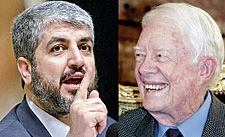
DAMASCUS, 19 April 2008 — Former US President Jimmy Carter yesterday defied US and Israeli warnings and met top Hamas leader Khaled Meshaal and the group’s deputy chief at their heavily protected office in the Syrian capital.
Carter’s meeting with Meshaal was the first public contact between a prominent American figure and Hamas officials since Rev. Jesse Jackson met with Meshaal in Syria in 2006. It followed two other meetings between the former American president and the popular Palestinian group in the region this week.
Carter’s convoy arrived at Meshaal’s office for the meeting under tight security and reporters were prevented from getting near the site. The meeting was closed to media.
Several members of the US Congress urged Carter not to meet Hamas leaders, saying it would confer legitimacy on the group. “We have a policy in this country about Hamas. And he is just deliberately undermining that policy, and it’s wrong,” Republican Rep. Sue Myrick told Fox News yesterday, calling for the State Department to revoke the former president’s passport.
But Carter, who brokered the 1978 Israeli-Egyptian peace and won the Nobel Peace Prize in 2002, defended what he called his personal peace mission, saying Hamas must be engaged in order to achieve Israeli-Palestinian peace.
Meshaal is no ordinary leader. He is highly respected by the Palestinians and dreaded by the occupiers. In 1997, Israel tried to kill him when Mossad agents sprayed him with poison on a street in Amman. Jordan’s late King Hussein, who made peace with Israel in 1994, forced Tel Aviv to send the antidote that saved Meshaal’s life. He later moved to Damascus in 1999.
Though Hamas won the 2006 Palestinian parliamentary elections by a landslide, it was never given the space to govern, both by Israel and the outside world.
National Liberation Movement
Hamas officials have said the meetings with Carter have accorded the group legitimacy. Mushir Al-Masri, one of the group’s leaders in Gaza, said the meetings with Carter were proof that Hamas was not a terrorist group, but a national liberation movement. According to him, countries and groups are beginning to understand that Hamas is a power to reckon with and the region will not have calm or stability without engaging the group. “It confirms the failure of the US and European policies of ignoring Hamas,” he said. “It confirms that all the countries that assume Hamas is a terrorist group should reconsider.”
Muhammad Nazzal, a top figure in the group’s political bureau, endorsed Al-Masri’s comments. “Political isolation of Hamas by the American administration has begun to crumble,” he told reporters after the Carter-Meshaal meeting.
Carter earlier met Syrian President Bashar Assad. Syrian news agency SANA said they discussed the peace process and relations between the two countries. The two men expressed “their support for dialogue in arriving at political solutions to problems” and considered it important to “mobilize efforts to reduce the suffering of the Palestinians and to lift the Israeli blockade on the Gaza Strip.”
In Beirut, US Assistant Secretary of State for Near Eastern Affairs David Welch said Carter’s conversations with Hamas leaders risked being misrepresented. “We are concerned to advance peace here. We see no intention on the part of Hamas in doing so and there is some risk that these conversations will be misrepresented by Hamas,” he said. But Carter insists he is not acting as a mediator and has been urging talks with Hamas and Syria, saying peace cannot be reached without them. “I think it’s absolutely crucial that in a final dreamed-about and prayed-for peace agreement for this region that Hamas be involved and that Syria be involved,” he said in Israel on Monday.
The Hamas delegation in Cairo also held talks with Egypt’s pointman on Palestinian affairs, Omar Suleiman, yesterday and vowed not to return home until negotiations on the reopening of the Gaza-Egypt border bear fruit.
“We gave clear and specific answers to the questions put by the Egyptian side. We expect an Israeli answer within a week so that we can settle the issue of the Rafah crossing once and for all,” Hamas’ Mahmoud Zahar told Egypt’s MENA news agency. “We are going to sort out all the remaining obstacles in the coming days and will not return to the Gaza Strip until we have done so... so that we can rid the territory of this unjust blockade,” he added.
The Rafah crossing between Gaza and Egypt, the territory’s only one that bypasses Israel, has remained almost continuously closed since June. Gazans blew open the border earlier this year but Hamas authorities resealed it pending an agreement on its formal reopening.
In Cairo on Thursday, Carter described Israel’s siege of the Gaza Strip as a crime and an atrocity. He said Palestinians in Gaza were being “starved to death,” receiving fewer calories a day than people in the poorest parts of Africa. “It’s an atrocity that is being perpetrated as punishment on the people in Gaza,” he said. “It’s a crime... I think it is an abomination that this continues to go on.”
ME Peace Conference
In Moscow, Russian President Vladimir Putin met Palestinian President Mahmoud Abbas to discuss plans for a Middle East peace conference, as Moscow seeks a greater diplomatic role in the region.
A Kremlin official told journalists that “special attention will be paid to possible steps by Russia, including its initiative to hold a Moscow meeting on the Middle East.”
The official said Putin and Abbas would discuss how to stabilize the situation and restore Palestinian unity.
Earlier in his visit, Abbas said a Moscow conference was urgently needed as Israeli-Palestinian talks started in Annapolis in the United States last November were “not advancing at the required pace or yielding the necessary progress.”
Separately Abbas told the newspaper Nezavisimaya Gazeta that the conference would “be evidence of Russia’s significance in the region and would strengthen her role in the peace process.”