
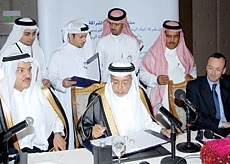
RIYADH, 30 April 2008 — In an effort to conserve water resources in the Kingdom and to ensure a consistent water supply, Saudi Arabia awarded a major contract to France’s Veolia Water AMI for water production, distribution and wastewater collection in Riyadh city. This is the first contract of its kind signed by Minister for Water and Electricity Abdullah ibn Abdul Rahman Al-Hussayen and a private operator represented by Veolia CEO Patrice Fonlladosa, here yesterday.
Addressing a press conference after the signing ceremony at the local Four Seasons Hotel, Minister Al-Hussayen said that this was the first time Saudi Arabia has awarded a contract for water services to a private operator, “but it is also one of the most important contracts in terms of the number of people served about 4.5 million inhabitants of the city and in terms of the length of the drinking water network of 10,000kms, as well as wastewater network of 4,500kms.”
“More than SR240 million will be payable to the Veolia Water on the basis of the performance indicators,” said Al-Hussayen, adding that Veolia Water would provide its services to the Kingdom’s National Water Company on the basis of an incentive system linked to the performance and savings achieved under this six-year contract. He said that there was an urgent need to reduce water leakage, which invariably amounts to nearly 50 percent of total water supply.
The signing ceremony was attended by a large number of water industry experts, Saudi officials, French officials and local businessmen.
On the question of high water consumption in the Kingdom, Al-Hussayen called for intensifying efforts to “reduce per capita water consumption, which exceeds 270 liters per person in Saudi Arabia, much higher than the EU countries.”
As part of its contract, Veolia will put in place a team of managers and operating experts that will be deployed in strategic areas such as the management of water distribution networks and wastewater collection systems, water production plants, capital investment planning and works supervision, customer management and human resources management. Almost 4,000 employees who currently work for public authorities will be transferred to the new management entity.