
“Dirty river-mouth" is probably not the first choice of names for a capital city or holiday destination. Do not be put off by that, because you would miss an absolute pearl of a place.
Kuala Lumpur does indeed have a river and perhaps you would not wish to swim in it. However, it has very much more to offer to both tourist and business visitor and has, unlike the well scrubbed Lion City (Singapore) 55 minutes by air to the south east, some delightful 'lived in' areas that exude a genteel disreputability that is entirely engaging.
That is quite in keeping with the city's ramshackle start at the junction of the Klang and Gombak rivers in 1857 as a trading post for the then burgeoning tin industry. It is not an old city; it is though a city that is fiercely proud of its history - all of it - including the days of British rule when it was made the capital of the newly formed Malay States. A multiracial and multicultural population settled there in enclaves which remain even today and provide the city with much of its attraction.
Today, Kuala Lumpur is Malaysia's financial and business capital, the government being located in Putrajaya, a sort of "Bureaucracy Theme Park" located between the city and the rather attractive main airport which stands next to the famous Sepang Formula 1 circuit, venue for the last 10 years for the Malaysian Grand Prix.
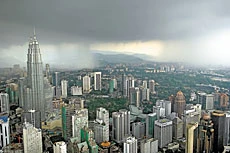
It is probably not possible to think of Kuala Lumpur without visualizing the 452-meter Petronas Towers. A magnificent structure by any standards, designed by Argentinean architect Cesar Pelli, this stainless steel and heat reflecting glass building dominates the skyline of the business district providing the "must have" iconic photo of any tour. The twin towers, which resemble a pair of minarets, and the eight-sided floor plan were designed to reflect the Islamic principles of unity and harmony.
Outside, a little innocent fun might be had - for free - watching the hordes of Chinese tourists standing in the line of sight of a perfectly decent building to stick their fingers in their ears and be photographed by equally photographically-challenged chums. One also notices the egregiously polite and smiling mendicant monk offering peace and love for a few ringgit and checking the exchange rate (when just out of sight - or so he thinks) to see if they were up to scratch in the donation stakes. Very tech-savvy these boys; how many mendicant monks do you know with a Blackberry to display his message of peace and goodwill in any one of several dozen languages?
But that IS Kuala Lumpur; it is all done with the greatest goodwill and good nature. Sure they want your loot - who doesn't? But in the process of extracting it there is never the slightest hint of threat and always an interesting diversion somewhere in the cramped and character filled nearby street. Little India with curries made to order; China Town with its incense filled temples and outrageously cheap street market; Kampung Baru and Chow Kit - for Malay and Chinese food from tiny restaurants or stalls (best in the city) - all lie within walking distance of the city center. Not that you would much fancy walking far; heat and humidity are quite a challenge - taxis cheap and plentiful.
The Golden Triangle - a local name for the hub of the city's nightlife - provides every diversion known to mankind and a few that are not! Foot fetishists tremble with joy; the main vogue pastime is foot reflexology massages with aromatic oils. Close behind seems to be jabbing pins into porcine Westerners; elegantly attired young ladies regale you in the street with pictures of such goings-on and invite you to their open fronted shops to partake of a needle or two, doubtless for the amusement of vicariously sadistic passers by with more sense. Local TV, as you may have guessed, really isn't up to much.
To catch a good portion of history, the best place to start is Dataran Merdeka (Independence Square). At the heart of the colonial district it is a large rectangular grassy field bordered by St Mary's Cathedral, the mock Tudor Royal Selagor Club, the National History museum and the deliciously ornate Sultan Abdul Samad building built in 1897 - a vast flamboyant confection of Moorish architecture and laboriously laid bricks (57 million of them, I am reliably informed) and now home to a division of the Malaysian High Court. It was designed by a British architect AC Gordon and draws on Egyptian, Mughal and Islamic style - symbolic of the rich ethnic mix of the country. On top is a magnificent town clock - a gift from Queen Victoria. It cost 376 shillings, the tour guides will tell you - that is £18.16s - or SR143. Hard to buy a plastic watch for that, now.
Tour guides point out that this was where the British set up governmental shop - bank, church and cricket pitch. Hard to see the connection, but all preserved and in superb condition and all still in daily use.
Close by, where the Klang and Gombak rivers meet stands the Masjed Jamek (Friday Mosque). Built in 1909 by A B Hubbock and the oldest surviving mosque in the capital it too is immaculate with three onion-shaped domes and minarets galore among the palm trees in the lush garden it nestles in.
Zoos of any sort to my mind are sad places. However with typical local panache the designers of the Bird Park, located in another almost virgin forest area, made it wonderfully free of the 'caged animal' syndrome of many zoos. It is a park and much of it has been covered with fine netting to make it the biggest aviary in the world. Many of the birds fly freely about the visitors wandering around inside the aviary and provide a real and very rewarding challenge to photographers.
Less of a challenge but rewarding in terms of images, railway history and sheer colonial pomp is the rather magnificent Kuala Lumpur Railway Station built in 1911. It is a majestic white building of Moorish arches, balustrades and cupolas designed by A B Hubbock - of Masjed Jamek fame. With the wonderful eccentricity and attention to engineering detail of the period, beneath the exotic Islamic exterior lies a station built to the British specifications of the day - including an iron roof capable of supporting 1 meter of snow. No excuse for slacking, even if there IS no one looking! Now only used for local commuter services, the station is well worth a visit.
No visit to Kuala Lumpur could possibly be complete without a real high tea in the revolving restaurant at the top of the Menara KL - the communications tower. Being Malaysia though, verdant jungle creeps in everywhere it can. The tower is built in an 11 hectare piece of Malaysia's oldest primal rainforest, the Bukit Nanas Forest Reserve. Gazetted in 1906, this legal status saved it from destruction when the tower was built - even requiring a reworking of the plans to preserve a 100-year-old Jelutong tree. The care of this small piece should come as no surprise, however; 60 percent of the country is covered in forests of which 50 percent is in reserves.
To call the view over the city from the top of the tower spectacular is the epitome of understatement. If you are really lucky, nature will provide you with an afternoon thunderstorm with afternoon tea. If you have never seen a thunderstorm on gray legs of warm rain stalk across a city shining silver in the low afternoon light and hurling bolts of forked lightning at high-rise towers, you just have not lived! The tea is good, too. And in a very properly organized manner, by the time you have dropped the 400 meters or so back to ground level, the rain has gone leaving a pellucid sky and a blissfully cool breeze.
Choice of hotels in Kuala Lumpur is dizzying. Even though a bustling capital city with enormous wealth, there are budget hotels that will not destroy your budget. Naturally mid range and the most fabulously luxurious abound. The Hotel Imperial on Jalan Sultan Ismail really lives up to its name - the food is simply exquisite and the lobby resembles a really select Vogue fashion shoot with its wide sweeping staircase and dark-wood furnishings.
If and when you visit Malaysia, spend some time in this dazzling city. Vibrant, modern, old, smoothly sophisticated and slightly risqué, it has it all.
And if you think you will get withdrawal symptoms if you do not visit a shopping mall, then it has those too jammed packed with all the usual suspects from up market fashion to expensive bling.
But the real fun of the place is not in the mausoleums to Mammon; it's just about everywhere else.
Useful websites:
www.tourism.gov.my, www.visitmalaysia.com and kualalumpur.gov.my