
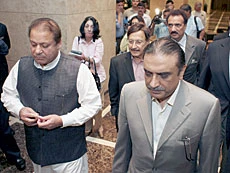
ISLAMABAD/DUBAI, 1 May 2008 — Pakistan’s new leaders yesterday failed to meet the deadline to reinstate judges ousted by President Pervez Musharraf, but officials said they would keep trying to resolve the dispute, which has threatened their month-old coalition government.
After some seven hours of talks in Dubai, “there has been progress,” said Chaudhry Nisar Ali Khan, a senior official in the party led by former Prime Minister Nawaz Sharif. He predicted that a final decision would be reached after another round of talks today.
Meanwhile, a spokesman for the main pro-Musharraf party, Pakistan Muslim League (Q), said yesterday that it would start work on its own proposal for restoring the judges and consider the possibility of joining a new ruling coalition if the current one breaks apart.
Musharraf purged the Supreme Court last year to stop legal challenges to his continuation in office. Musharraf’s political allies were routed in February elections by the parties that formed the new government. The new ruling coalition had promised to reinstate the judges by the end of April, but its leaders have yet to agree on exactly how.
The larger coalition partner, the Pakistan People’s Party led by Asif Ali Zardari, wants to link the restoration of the judges to a proposed package of judicial reforms that could narrow the powers of deposed Chief Justice Iftikhar Mohammed Chaudhry and prevent judges from getting involved in politics.
Zardari has accused Chaudhry and other judges of “playing politics” and failing to deliver justice to him during the years he spent in jail on unproven corruption charges.
Sharif has said the two parties must honor a pledge to use a parliamentary resolution to restore the judiciary to the position it held before Musharraf declared emergency rule on Nov. 3. But he has urged the broader reforms be kept separate.
“The resolution is a simple resolution ... we will be very happy to look at the constitutional package whenever it comes to us,” Sharif told reporters.
Sharif said earlier that he “wholeheartedly” wanted to keep the coalition intact. His party has threatened to pull its ministers from the federal Cabinet if the judges issue drags on, but says it will remain part of the coalition.
A close Zardari aide suggested late on Tuesday that the alliance risked collapse over the issue.
Sharif’s party had “suddenly” balked at the wider reforms, Information Minister Sherry Rehman said on Dawn Television. “We will still carry on. It will be very regrettable if there is a break in the coalition,” Rehman said.
But yesterday, in between sessions, Zardari said “Yes, obviously,” when asked if the coalition was as strong as ever.
And officials from both parties sought to downplay the April 30 deadline.
Farhatullah Babar, a spokesman for Zardari’s party, told Dawn Television that the deadline was “not critically important” as long as the deal eventually reached was smoothly implemented.
As yesterday’s sessions ended, Chaudhry Nisar said “a few days ... a few hours here and there doesn’t matter. But the fact of the matter is the final decision would be made tomorrow and I am saying this very categorically.”
Musharraf removed Chaudhry just as the Supreme Court was preparing to rule on the legality of his election in October to a new five-year presidential term. Musharraf accused the chief justice of corruption and conspiring against him and his plans to guide Pakistan back to democracy.
Chaudhry had shown an unusual degree of independence, blocking government privatization deals and investigating complaints that its spy agencies were holding opposition activists secretly under the cover of fighting terrorism.
Some analysts predict Musharraf might have to quit if Chaudhry is restored and the court revisits the president’s disputed re-election.
Sharif, whose government was ousted in Musharraf’s 1999 coup, is demanding the ex-general’s ouster. Yet Zardari’s liberal party has repeatedly hinted it could govern without Sharif.
The political brinkmanship has stirred talk in the local media about the revival of a power-sharing deal between Musharraf and Benazir Bhutto discussed before she was killed in December.
The main pro-Musharraf party, now in the minority, was reconsidering its options. PML(Q) spokesman Tariq Azeem said his party would start work on a resolution aimed at restoring the judiciary — including Chaudhry — if the current coalition could not offer a proposal.
Asked if Musharraf agreed with the intended move, Azeem said “much water has passed under the bridge and the ground reality has now changed, which requires resolution of the judicial issue as the entire judicial system is jammed and people are suffering.”
Azeem also said the party would consider whether to join Zardari’s party in a coalition if Sharif’s party leaves the government. “We will see as to what are the terms and conditions for doing so,” Azeem said. “We cannot rule it out.”
Also yesterday, Zardari’s party agreed to share power in Sindh with Muttaheda Qaumi Movement (MQM) which backed the previous pro-Musharraf government. Officials said there were no plans for the MQM to join the federal coalition.
— With input from agencies

