
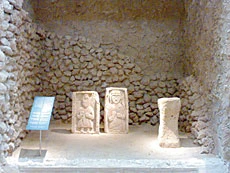
MANAMA, 9 May 2008 — Bahrain fort, or Qalat Al-Bahrain as it is known in Arabic, is all lit up for visitors after undergoing renovation and is a must-see for those historically-inclined. The lighting ceremony at night is a highlight of the visit to the museum. It opened to public in February 2008.
Named a UNESCO World Heritage Site in 2005, the museum is located on the island’s north coast on the site of Dilmun settlements. The settlement is one of the most important ancient civilizations of the region dating back to 3,000 BC.
The fort museum, built on a hill, sprawls over an area of more than 17.5 hectares. The museum comprises some 5,000 archaeological pieces found at the site of an ancient fort discovered by Danish excavators. The pieces represent all ages and eras of the Dilmun civilization (3200-1600 B.C.).
Dilmun was known as the land of living or the land of eternity according to the Sumerian mythology.
Enki was the deity of water, intelligence and creation. On one ancient tablet dated 3100 B.C., Dilmun is described as an “Elysium” where the inhabitants were eternally young and suffered no illnesses.
Inhabitants of the island believed that they would return one day to their past glory because theirs was the land of eternity.
Bahrain is one of the world’s largest necropolises with an estimated 170,000 graves, most of which date back to the third and second millenniums B.C. Some believe that the ancient Egyptians buried their dead here.
The people of Dilmun used sarcophagi to bury their dead. It is a funeral receptacle for a corpse, made of mud and designed to be placed underground. They used to sacrifice snakes for fulfillment of certain needs. They believed that if live snakes were buried under their houses they would be able to protect their women and cure infertility.
They used to put a snake and an eel alive in a tazza (a shallow saucer-like dish) and bury them in their houses. They also added jewelry like gold and pearls to this sacrificial offering.
The museum also exhibits the ancient war tools, such as the mangonel (historical catapult) and hand grenades, found in Bahrain fort. There were also bows and arrows used to attack faraway targets.
Explosive devices used in ancient times were also on display. They were of three sizes — small ones for targeting infantry, medium ones to attack vehicles and the big ones to blast huge blocks.