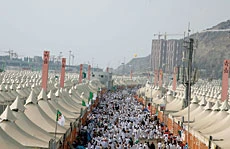
JEDDAH, 12 May 2008 — The tent city of Mina is one of the 55 city projects that have been selected from 226 nominations from across the world for exhibition at the World Expo 2010 Shanghai.
A 20-member jury picked the winners to be exhibited at the exposition’s Urban Best Practices Area (UBPA).
“Saudi Arabia was the only Asian Arab country to win a place in the expo,” said Dr. Abdul Rahman Al-Asheikh, deputy minister of municipal and rural affairs for town planning and the Kingdom’s representative to World Expo 2010.
Judges picked the tent city by taking into consideration the Kingdom’s efforts to provide modern services to nearly three million pilgrims who spend four days in Mina during the annual Haj pilgrimage.
The Kingdom has spent nearly SR25 billion in developing the desert valley of Mina into a modern city. Mina now has 40,000 durable fireproof tents with cooling systems, state-of-the-art communication facilities that include flyovers and tunnels, and water and electricity networks.
“For the first time, the tent city of Mina will be displayed at an international exhibition,” Al-Asheikh said. “Projects proposed had to be something that had been physically implemented on the ground,” he said, speaking about the strict criteria to qualify for the exhibition.
He added that the Ministry of Municipal and Rural Affairs is currently finalizing the design for the Kingdom’s pavilion at the show, adding that the pavilion would cover 6,000 square meters.
“We have conducted a contest for designs and received 22 entries. We’ll choose the best among them,” Al-Asheikh said.
Other projects selected for the expo after a nine-month worldwide search included Brazil’s Porto Allegre, protection and use of historic canals in Venice, and Shanghai-EcoHousing. The projects which are not selected for the six-month exposition may still be exhibited for one day or 10 days. Three spots will be left open for projects to be built by developing countries.
All projects feature innovative solutions to urban problems and issues, such as water treatment, energy conservation, transport, social interaction, and bringing residents into closer contact with nature. The projects illustrate innovative ways to realize “Better City, Better Life” — the exposition’s theme.
Of the 54 other cities selected, 29 were European, 10 Chinese (including one from Hong Kong), one from Macau, two from Taiwan, five from the US and Canada, two from South America, two from Africa and one from Australia.
“Many projects have striking features. All these cases have real models and they are successful practices. They are enlightening in terms of the influence they have on people’s lifestyles,” said Zhou Hanmin, deputy director-general of the Bureau of Shanghai World Expo Coordination.
“We can’t deny that European cities have better experiences in urban development, but we are seeking balance among different continents, and between developing and developed nations,” said Zhou.
The Urban Best Practices Area, which is located on a site larger than 15 hectares, offers a stage for cities around the world to propose their solutions to urban issues from different perspectives.
Originally, organizers planned to choose some 30 examples for the exhibition. They later decided to increase it due to the overwhelming number of proposals from around the world.