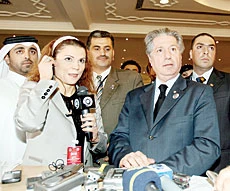
DOHA, 19 May 2008 — Lebanese leaders made progress toward ending their political crisis yesterday but talks foundered on the second day of the Qatar-hosted meetings as Hezbollah stuck to its refusal to discuss any possibility it would give up its weapons.
Qatar’s Emir Sheikh Hamad bin Khalifa Al-Thani met members of the ruling coalition and Hezbollah-led opposition to try to bridge differences.
Delegates said Sheikh Hamad brought together Prime Minister Fouad Siniora and Parliament Speaker Nabih Berri, a senior opposition leader, for the first time in 18 months as part of efforts to solve the crisis that has left Lebanon with no president and taken it close to civil war.
Delegates said the differences were slowly narrowing over the two key issues on the agenda — a new election law and power-sharing in the government.
But talks may yet stumble over a demand from the governing coalition for clear guarantees that Hezbollah would not turn its guns on them again and that the fate of its arms would be debated in Lebanon soon. The fate of Hezbollah’s weapons is not on the agenda of the Doha talks.
Hezbollah’s chief negotiator, Mohammed Raad, accused the government of trying to “blackmail” the opposition by raising the subject of Hezbollah’s weapons. He said the group’s “weapons and capabilities are beyond any discussion” and were not supposed to be on the agenda in Doha.
Notwithstanding the sensitive issue of Hezbollah’s weapons, the talks appeared to make headway yesterday.
“I think we have resolved 90 percent of the hurdles facing the new election law. We have some obstacles left regarding some electoral constituencies,” said Amin Gemayel, a former president and member of the ruling coalition.
Meanwhile, the talks evoked mixed reaction from Lebanese people. “We, the Lebanese community in Doha are praying for a speedy solution to our political problems,” said Lebanese businessman Samir Nakhoul. Talking to Arab News, he said Hezbollah, as the largest political force, should integrate into the country’s political mainstream. “We should not let anti-Lebanese forces influence our decisions,” he said.
Nadim, another Lebanese resident here, said, “How can an elected government allow a parallel government to function. Hezbollah is almost running a government inside Lebanon. They have to disband their militia and integrate into the Lebanese Army.”
— With input from agencies