
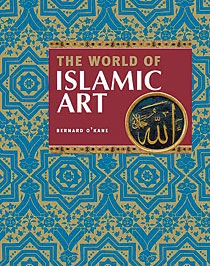
The recent publication of “The World of Islamic Art” is an open invitation to go beyond the war on terror and the negative stereotypes of Muslims. This visually spectacular book offers its readers a chance to discover the beauty, peace and harmony of Islamic art.
The author, Bernard O’Kane, reminds us that the term “Islamic Art” is quite recent and was first used by European scholars in the late 19th century. It refers to the art produced in countries ranging from Spain to China from the 7th century to the present. Since Islam embraces all aspects of life, Islamic thought and Islamic art are inextricably linked. Beauty in Islam is also considered a Divine Quality; therefore Islamic art is essentially an expression of beauty and truth. It is also interesting to note that in traditional Islamic societies there existed no distinction between fine arts, major and minor arts or religious and secular arts. Moreover, in Arabic, the word for art is ‘fann’ which is making something correctly but the act itself should be combined with wisdom. Thus anything from cooking, to sewing, writing or playing music has its own form of art or ‘fann’.
“The World of Islamic Art” highlights mainly Islamic art before the 19th century; the Petronas Towers, winner of the Aga Khan Award for architecture, is the only recent example of Islamic art shown in the book.
“With the arrival of modern communications in the 19th century, the Islamic lands were no longer as self-contained as they had been earlier and Islamic art and architecture become a part of world art. And with the increase of modern communications, it may become increasingly difficult to separate Islamic art from modern art. But visual artists and architects are certainly still producing excellent examples at the moment” explains O’Kane.
When the renowned art historian Titus Burckhardt was asked to define Islam, he replied: “Go and see the Ibn Tulun Mosque in Cairo.” Islamic art not only appeals to anyone sensitive to art but it is also an essential key for the understanding of Islam.
The stunning illustrations featured in this book, convince us ever so easily that Burckhardt had a wealth of architectural examples to choose from. The Dome of the Rock, the Great Mosque of Cordoba, the Alhambra in Granada, the awesome mud brick Mosque of Djenne in Mali, the Friday Mosque in Isfahan, the Madrasa of Ulugh Beg in Samarqand, the Selimiye Mosque in Edirne, the Taj Mahal of India, the Great Mosque of Xian are just a few masterpieces of Islamic art.
In the seven chapters of this stunning work, the author attempts to highlight the vast span of Islamic art. Beautiful photographs draw attention to the great architecture and exquisite handicraft produced under the Umayyad and Abbasid caliphs as well as under the Fatimids, Ayyubids, Mamluks, Seljuks and Ottomans. A section also brings to light the Islamic treasures in Spain and the Maghreb and the last chapter features India, Southeast Asia and China.
In his introduction, O’Kane mentions the famous Iraqi-born architect Zaha Hadid who symbolizes the “intermingling of artistic traditions on the world stage which will enable Islamic art and architecture both to reach a broader audience and reinvigorate itself with the carefully selected adaptations that characterized its first appearances.” More than local cultures or other sources of inspiration, however, the principles of Islamic art are essentially derived from the inner truth of the Qur’an and the Sunnah of the Prophet (peace be upon him). Islamic art remains foremost a beautiful manifestation of the universal truth of Islam.