
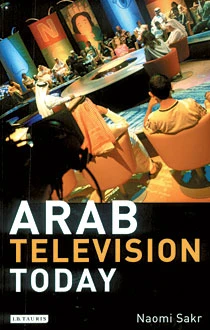
Arab Television Today is a sequel to Naomi Sakr’s “Satellite Realms” which was awarded the Middle Eastern Studies Book Prize in 2003. Naomi Sakr, the author, is a Reader in Communication in the School of Media, Arts and Design at the University of Westminster and this goes some way to explain the overtly academic style of the work.
The book offers a sharp insight into the present state of the television industry in the Arab world. The author goes behind the scenes to show how the close interplay between owners, investors, journalists, producers and advertisers covers the entire Arab region and communities abroad.
A growing number of viewers in Arab countries have been watching satellite television since their first appearance in the 1990’s. In Lebanon, Algeria and Saudi Arabia, 90 percent or more of television households receive satellite channels. This new Arab media has not only put forward a new-style journalism but it has also introduced a number of programs whose format and content were previously unknown in the Arab world.
The author points out that Arab analysts agree that the arrival of satellite channels did not sever the relations of patronage that previously dominated the region’s television output. She also rightly suggests that where Arab television is concerned, instead of inquiring about political pressures, one should focus on licensing commissions, independent production houses, professional alliances, audience research agencies, advertisers’ trade associations and media watch groups as a means of establishing autonomous platforms to express any shared or conflicting interests.
Arab satellite channels fall basically into three categories, defined by contrasting approaches to the broadcasting business. First, viewers are seen as a potential market for items to be advertised during program breaks; second, viewers are addressed not as a market but as a public with information needs. A third approach makes a distinction between satisfying market demand and satisfying the demand for favorable publicity on the part of well-known politicians.
Arab journalists are presently attaining celebrity status and their profession has begun to enjoy prestige: “They are reaching for a kind of reporting about Arab affairs that was possible neither inside nor outside the Arab world in the past...all are convinced that local news in most Arab countries has been neglected for so long,” writes Sakr.
Nabil Khatib, chief of MBC’s Jerusalem bureau for several years and then executive editor of Al Arabiya explains: “For 50 years, all Arabs have heard about is Israelis, Palestinians, Americans, Arab summits and so on, and nothing about real answers to the real questions of why Arabs are poor, frustrated, and unhappy with the level of health care and education for his children... We are inventing the basic tradition of being sensitive to public interest and we need to fight for it.”
In one of the book’s most interesting passages, Naomi Sakr brings up the subject of objectivity. Arab television editors, reporters and presenters who believe in objectivity do not reflect a consensus on this issue in their own societies. In this respect, Al Arabiya’s Nabil Khatib observes that conflicting pressures were making it hard for the so-called new Arab media to take ‘difficult decisions about priorities’ or broadcast ‘news about issues those in power do not want the public to know.’ Furthermore when reporting on Israeli forces hitting Palestinians or the Israel-Lebanon war, journalists have to deal with their emotions. Jihad Ballout, who moved from Al Jazeera to Al Arabiya in 2005 explained to AFP: “A journalist cannot be isolated from his roots and feelings. I cannot imagine being impartial... But there are certain measures in practice to preserve objectivity”.
The proliferation of satellite channels has brought to the forefront the question of gender and power balances between men and women. Queen Rania of Jordan created an advisory council called the “Arab Women’s Media Campaign” to remind heads of satellite channels and other media leaders that they had a role to play in correcting misconceptions about Arab women. Many feel that satellite channels are a means to exchange ideas, a medium of education and a platform for ‘empowerment’ but where women are concerned, television programs exploited the differences between’s women’s visibility in different countries to attract viewers. Lebanese channels aired early aerobics programs and entertaining shows at night. Lebanese anchor women are known for wearing attractive clothes and extravagant jewelry more appropriate for a gala evening than for reading serious and often dramatic news. Najat Sharafeddine of Future TV recalls a Lebanese director telling female presenters that viewers wanted to see them rather than to listen to them.
On the whole, the expansion of television opened the door to a growing number of female journalists, reporters, editors and producers. Women are even reporting business and financial news. Jamil Al-Hajj, head of finance and economy at Al-Arabiya, admitted that his main priority was to find experts who would not make mistakes when covering stock-market trends and other financial matters that could affect viewers, investments and savings. Furthermore, the new Arab media showed advertisers the importance of female viewers as consumers. Presently, an increasing number of Arab and foreign programs, morning shows, serials, religious programs, talk shows, target a female audience in order to reach that lucrative market.
Another profitable business concerns the production of entertaining programs. As Naomi Sakr rightly points out, “The prevalence of a single language in a total Arab population of some 300 million in 22 countries is a rare phenomenon in comparison to other regions.”
It seems however that the most popular channels rely heavily on Western-style formats and large-scale imports of foreign serials and films. On the other hand, local production of films and serials is far below its highly profitable potential.
“Television companies appeare to be preoccupied with the immediate and short term, giving very little thought to sustainable programming strategies that would foster production capacity at the national level and nurture the local creativity which local audiences have shown they appreciate,” writes Sakr
Novel talk shows have also enabled the satellite channels to attract viewers. The controversial Faisal Al-Kasim admitted that he enjoyed “defrocking political figures and de-iconizing icons.” But despite the controversial issues discussed in these talk shows, Arab broadcasters do not seem to have made a profit from them. Furthermore, the lack of profitability in Arab satellite channels is due to problems linked to advertising budgets. Sakr highlights the low level of spending in a region where oil revenues boomed before and after the US-led invasion of Iraq in 2003. The other problem concerns the wide disparity in advertising rates charged for different shows, rocketing prices for some slots leveling out to much cheaper prices elsewhere.
The necessity of maintaining an audience share has often led to flawed statistics but major advertisers have now pushed for long-delayed upgrading of data thanks to the introduction of people meters in three Gulf countries.
“Arab Television Today” gives us a fascinating insight into the new Arab media. We are drawn into the problems faced by satellite television with its news, talk shows and entertaining programs. We are also made aware of the presence of conflicting influences on Arab TV journalism and get a glimpse of the business strategies of the main TV firms.
Naomi Sakr concludes: “Established firms with the backing of powerful political forces continue to enjoy big advantages in their political ability to control economic aspects of the business.”