
COLOGNE, 3 June 2008 — Long before next Sunday’s Canadian Grand Prix, the team behind Panasonic Toyota Racing will have been using tools in the virtual world of simulation to give their drivers’ an edge on the Gilles Villeneuve Circuit. The 2008 Toyota challenger, the Toyota TF108, was just launched in January and this will be its first experience with Montreal’s Ile Notre-Dame, but Panasonic Toyota Racing (PTR) engineers already have a bank of information to draw on after simulating the car’s behavior around the 4.361 km track. At the team’s technical center in Cologne, Germany, an array of sophisticated simulation techniques are employed to give the drivers a head start in Canada, ranging from the wind tunnel, engine test benches, a seven-poster rig and computational fluid dynamics (CFD).
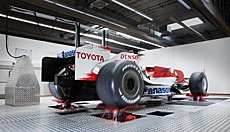
For the Canadian Grand Prix, riding the curbs — the edges of the track, especially at the curves — is key, and Panasonic Toyota Racing has spent time simulating the TF108’s behavior on a seven-post rig, specifically set up to replicate the demands of the Montreal track. A full-size TF108 is placed on a hydraulically-powered rig, which uses data from previous seasons to shake and shudder the car exactly as though it was driving over the bumps and curbs of the Ile Notre-Dame. This provides important information regarding suspension and damper settings, giving engineers a strong indication of what works and what doesn’t.
“This is very important because, unlike other circuits, at Montreal you have the four chicanes (sequences of tight, serpentine curves) and the more you can ride the curbs in the chicane, the more you can straight line them and the more time you’re going to gain,” said PTR Chief Engineer Race and Test Dieter Gass. “That means if you have a car that handles perfectly over the curbs you’re going to gain a lot of speed and lap time.”
That is just one element of the standard pre-race preparation at Panasonic Toyota Racing; the engine dynamometers, or test benches, are another. An engine test bench allows the RVX-08 engine to be “driven” on its own, with no TF108 chassis in sight. By pushing the engine through all the same revs and gear changes as Jarno Trulli and Timo Glock will in Canada, an engine can complete the entire race distance without moving a millimeter. The data from these tests allows engineers to fine-tune engine behavior to a particular circuit, as well as spotting any areas to improve well before the drivers hit the track.
“Typically, before Canada or any other race, we have in our computer the complete throttle behavior that can, for example, reproduce Jarno’s driving style at that track on the dyno,” said PTR Senior General Manager Engine Luca Marmorini. “In this way we can already start to anticipate some potential problems in terms of engine response or engine mapping that the driver and the team might find in Canada.”
These preparations are specific to each race but simulation goes on across the board as Panasonic Toyota Racing strives for the continuous improvement necessary to compete at the front in Formula 1. The fruits of this work eventually make it to the race track, but not before rigorous testing has proved their validity in advance. Before every new aerodynamic part is fitted to the TF108, it has been thoroughly analyzed back in Cologne to ensure it does its job. The first part of this process sees virtual testing using CFD - computers which simulate air flow over a new part, and the impact it has on the car as a whole. If a part fails this process it is extremely unlikely to be worth pursuing, so this simulation streamlines the development process and ensures only worthwhile projects progress beyond the virtual drawing board.
“We live in a digital world now, we have to recognize that, and in Formula 1 we are pushing the limits of simulation and the utilization of computer power to absolutely understand where performance can be found in the future,” commented PTR President John Howett. “So even though we still use track testing and wind tunnel testing, normally the area we’re looking in is predefined by computer simulation and we’re looking in a fruitful area where we can cultivate performance.”
If the CFD tests are successful, the virtual part becomes reality and faces wind tunnel tests, where a scale model is blasted with air to recreate the effect of driving at speed, including simulated track conditions, ride heights and many more factors. Only then would a part be considered for use on the car itself. However, no amount of simulation can ever guarantee a perfect set-up; that has to be finalized on track.
“Simulation faces natural limitations so what is essential when you use it is to know exactly the limits. You cannot expect the simulation to tell you exactly how stiff your suspension has to be, for example. What you can expect from the simulation is to give you some direction. It will give you a diagnostic,” said PTR Senior General Manager Chassis Pascal Vasselon.
So, while plenty of work awaits the Panasonic Toyota Racing engineers and drivers when they arrive at the Gilles Villeneuve Circuit on Friday, they can begin setting up for the race safe in the knowledge that in the virtual world, they are as well prepared as possible for the task ahead.