
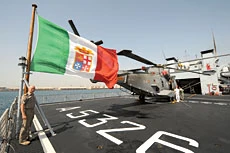
More than any other transport, a warship imposes its presence even when at peace. However, the name is not new to Jeddah; neither is the diplomatic/military function new to an Italian ship proudly bearing the name Etna.
Although its arrival in a foreign port may be with the most peaceful of intent — as was the case with the Italian Navy’s first Logistic Support ship the ITS Etna on a recent courtesy visit to Jeddah — its uncompromisingly functional shape and the drab though immaculate paintwork carried with them the messages of the ship’s potential for sterner action. Etna’s escort, the ITS Commandante Borsisni with its raked ‘stealthy’ superstructure and sharply angular hull was the embodiment of the military ‘no nonsense here, please’ approach to peacekeeping.
It was, it seems, an effective approach as freelancers with piratical intent off Somalia discovered during Etna’s four-month deployment. “Our tour of duty was part of Operation MEDAL 2008,” said Captain Giorgio Gomma. He explained that MEDAL was an ongoing plan whose primary objective was to meet and foster cooperation with other navies operating in “the wider Mediterranean sea.”
The two-ship Italian naval group paid a three-day courtesy visit to Jeddah in mid-May. The group, commanded by Captain Gomma, was returning to its home port of Taranto after a little more than a four-month tour of duty in the Gulf, Arabian Sea and the Somali Basin.
Other aspects of the tour were to demonstrate the newest and most advanced ships of the Italian Navy and to form part of a continuing presence on the seas of the Middle East and north east African waters with the aim of deterring piracy or other illegal activities. During her tour of duty, Etna interceded on behalf of a Panamanian registered vessel that was receiving the close attentions of pirates from the African coast.
The Etna, whose motto is “Tenacious Everywhere,” is essentially a re-supply and support ship. Nonetheless it also provides security to Italian and international commercial shipping in the sometimes hazardous trade routes in the area it patrols. “Just by being there, a military ship in the area provides a level of security to commercial shipping,” said Gomma. The Etna monitors all the radio channels and if a ship is approached by what are determined as pirates in high speed craft, she responds. As the pirates also monitor the same frequencies to locate prey, when they learn that there is a military ship in the area, they are usually deterred. “We have launched our helicopter on occasions to provide support to threatened ships,” Gomma said.
During the Etna’s visit, one of only five in the last 20 years or so, divers cross trained with personnel from the Royal Saudi Navy (RSN) and carried out underwater inspections and routine maintenance on the ship. The officers from the ship made contact with colleagues in the RSN and renewed long standing acquaintances.
Part of the group’s visit was devoted to hosting a visit by pupils from the Italian school in Jeddah and an on-board reception for members of the local Italian, Saudi and other guests from the expatriate community. There is a commercial aspect as well, Gomma noted, which is to display the best of Italian technology and naval equipment to host countries.
Although bearing a characteristically Italian name, it seems that a somewhat less magnificent vessel bearing the same name visited Jeddah in 1893. In 1873 a 70-meter iron single screw passenger steamer was re-engined in England. By 1887 it was owned by ‘Alfred Laming & Co.’ of London, registered at Liverpool and had been re-named Etna. The vessel was re-boilered’ in early 1893 and on May 13 that year — 115 years to the day after the ITS Etna docked in Jeddah — left Swansea in Wales bound for Yanbu and Jeddah via Tangier. It was carrying pilgrims to Madinah and Makkah. A Sept. 8, 1893 report in Lloyd’s Register advises that 100 passengers (pilgrims) and eight crew members aboard the Etna died of cholera in the Red Sea en route from Jeddah to Kamran, an island north of Hodeidah in Yemen and a “sanitary station for inward pilgrims from the East.” The vessel returned to Jeddah and then via Yanbu, Beirut and Algeria to England.
Almost simultaneously, on Mar 22, 1893, the Italian steel protected-cruiser Etna, under the command of Admiral Magnaghi sailed from Spezia for New York to take part in a large naval demonstration. The Etna was a comparatively new vessel, having been completed in 1885 and equipped with heavy guns and torpedoes. She was capable of what was in those days a very respectable speed of seventeen knots. The Etna was one of five heavily armed vessels: Etna, Vesuvio, Stromboli, Ettore Fieramosca and the Giovanni Bausan. Oddly, 123 years later, the modern Etna has a similar 18-knot speed capability for 7,600 nautical miles.
To complete the trinity of coincidence, on April 26, 1893, the Sicilian volcano, Mount Etna, erupted causing damage to land and property in the area. The eruptions, accompanied by explosions caused by groundwater encountering white hot magma, continued for over five years until June 1898. Having completed her duties of providing Italian naval capability for the naval exercise and a round of diplomacy, Etna returned to New York where, on Wednesday August 23, 1893 the New York Times announced that the repair of damage to the Etna caused by a recent storm. The Flavio Gioja had dragged anchors and collided with the Etna. “The Italian fleet will probably sail to-day for Algiers,” wrote the Times. “The fleet consists of the Etna, Vitorio Emmanuele, Amerigo Vespucoi, and Flavio Gioja. From Algiers the Italian ships will proceed, the Etna to Naples and the three remaining vessels to Leghorn.”
The modern ITS Etna is a very different proposition. The Etna (A5326) is a naval replenishment and logistic support ship built for the Italian Navy by Fincantieri at their Riva Trigoso Naval Shipyard where the ship was launched in July 1997. Following successful sea trials in November 1997, the ship was delivered in February 1998.
Etna’s function is to support the long-range missions of a naval squadron, which typically include an aircraft carrier and complete escort. The logistic support vessel has to be in position to refuel the squadron, including the air wing of the carrier, and also provide full logistic support in terms of repair workshops, spare parts, ammunition replenishment and supplies.
MM Etna is also capable of performing civil protection roles at times of crisis. The ship has high independent on-board capacity to provide electrical power, fresh water and prepared meals and also has fully equipped hospital and medical facilities on board.
The rear flight deck usually accommodates a helicopter such as the EH101 Merlin or the Agusta Bell AB 212. The hangar is large enough to accommodate a helicopter or four 20ft standard containers.
It is her capacity for replenishment and refueling at sea that provides Etna with her role. Etna can re-supply two ships simultaneously by using four Replenishment at Sea/ Fuel at Sea systems mounted on her expansive deck. She can transfer solid and liquid cargo, including fuel, aviation fuel and fresh water.
It is at first glance odd that a logistics support ship should share the name of a destructive geological feature. However, the Sicilian volcano, perfectly capable of bursting into spectacular activity at any time, is also a very fertile area, bearing olive groves, and plantations of exotic fruits and vegetables and copious amounts of water. The supply ship that bears the name of the volcano is capable of sudden action when called upon.