
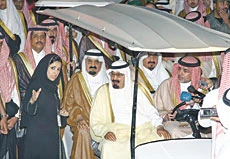
RABIGH/JEDDAH, 12 June 2008 — Custodian of the Two Holy Mosques King Abdullah yesterday launched several key investment projects worth SR138 billion at the King Abdullah Economic City (KAEC) in Rabigh, which is located around 200 km northwest of Jeddah.
King Abdullah expressed his confidence that the present and future projects at KAEC would make a qualitative addition to the national economy. He hoped that the giant economic city would benefit the whole Islamic world and called for the establishment of a mosque in every district of the city.
Amr Al-Dabbagh, governor of the Saudi Arabian General Investment Authority (SAGIA), said KAEC is one of the fruits of King Abdullah’s futuristic vision and that the cost of its building, including infrastructure, would be borne by the private sector.
KAEC has set a new benchmark in creating economic growth opportunities in the Kingdom and has already attracted investments in several high-growth sectors such as industry, seaport, hospitality and real estate.
According to SAGIA, the new projects launched by King Abdullah require over SR130 billion in capital investments.
On arrival at the city, King Abdullah was welcomed by Al-Dabbagh, Mohamed Ali Alabbar, chairman of Emaar E.C., Abdullah Saleh Kamil, vice chairman of Emaar E.C., and Fahd Al-Rasheed, CEO of Emaar E.C., and senior government officials and other dignitaries.
King Abdullah highlighted the role played by the economic cities in enhancing the competitiveness of the Saudi economy and ushering in socio-economic prosperity. He officially inaugurated the rollout of the Sea Port and the Industrial Zone, which includes a complete industrial city and plastic industry projects.
Opening a new era in the Kingdom’s industrial climate are two initiatives — the aluminum smelter developed in association with EMAL and the Total Oil factory. King Abdullah also initiated work on the SAGIA building, the Smart City Center, and infrastructure relating to general public utilities and transport.
In addition, he flagged off the Knowledge Industry projects, including infrastructure work for the Smart City, and unveiled the Healthcare City, the Media City, the Science Research Complex, the Environment Protection Center, the Cadre Technical City for Human Resources Development, and the Thunderbird and Colombia Universities. Other significant launches were made in the tourism and services sector — including the Ritz-Carlton Hotel & Resort and Convention Center, the Bay La Sun Hotel and Mall, and the Holiday Inn Express Hotel.
“This project will primarily focus on building human beings,” Al-Dabbagh said, adding that a number of leading international educational and training institutions would invest in the city. Emaar E.C. has offered 5,000 scholarships to boys and girls from Rabigh to achieve necessary educational qualifications to work at KAEC.
“KAEC has been able to attract investments totaling more than SR130 billion within a short period,” Al-Dabbagh added. “We have conducted a study to make sure projects implemented at KAEC would not affect the environment.”
Later, King Abdullah, Crown Prince Sultan, and senior princes and Cabinet ministers watched a documentary on projects in the city.
The hospitality projects at KAEC have so far attracted SR79 billion, plastic industries SR32 billion, knowledge-based industries SR24 billion, and educational and training projects SR3 billion.
In a statement on the occasion, Mohamed Ali Alabbar said Saudi Arabia, under King Abdullah’s guidance and visionary leadership, has consolidated its premier position as one of the world’s most competitive economies.
“Saudi Arabia has rolled out several initiatives aimed at enhancing the socio-economic prosperity of Saudi citizens — the economic cities not only create new job opportunities but also attract foreign investment,” he added.
In a similar statement, Abdullah Saleh Kamil thanked King Abdullah for his guidance and support in developing KAEC for the benefit of Saudi citizens. “The king’s visit to KAEC highlights the government’s continued interest in the project, which inspires us to speedily implement the project,” he said.
“This is on a scale unheard of before,” said Fahd Al-Rasheed.
“KAEC includes one of the largest ports in the world, an education zone, a resort zone etc. It is the size of Washington, DC, and is being built in 15 years.”
He added: “It is creating a vibrant growth sector under the guidance of King Abdullah, and offers Saudi nationals the opportunity to set up businesses in industry and manufacturing, apart from gaining employment opportunities.”
Emaar E.C. already has a strong workforce of which around 64 percent are Saudis. More than 7,000 professionals are currently employed on site with the number expected to increase to 10,000 in a year. KAEC has the potential to create one million jobs and will be home to two million people.
“I think it is most important for Saudi Arabia to diversify,” said Saad Al-Dosary, president and CEO the Rabigh Refinery and Petrochemical Company. “You are not just talking about the economy and getting revenues. You are talking about creating job opportunities.”
Located on the Red Sea coast on 168 million square meters of land, KAEC has six components: the Sea Port, the Industrial Zone, the Central Business District, the Educational Zone, the Resort District and the Residential Communities.
Emaar E.C, established in September 2006, is a Saudi joint stock company managed by one of the world’s largest property developers, Emaar Properties, and a number of high profile investors from Saudi Arabia. Emaar E.C has a share capital of SR8.5 billion consisting of 850 million shares. Thirty percent of the equity, worth SR2.55 billion, was offered for public subscription.