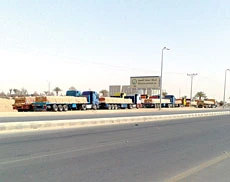
BURAIDAH, 13 June 2008 — Following Custodian of the Two Holy Mosques King Abdullah’s recent order banning the export of construction materials, such as cement and steel, to neighboring countries, traffic on Al-Asyah Road, which links Hafr Al-Baten to Qassim province in northeastern Saudi Arabia, has returned to normal.
“We are happy over the sudden absence of overloaded trailers from Al-Asyah, as these trailers have seriously damaged the newly constructed road linking Qassim to Hafr Al-Baten and Kuwait,” said a source at Al-Asyah Municipal Council.
The source explained that cement trucks were the only main concern as the Qassim Cement Company, which is located less than 40 km west of Al-Asyah, exports large quantities of cement to Kuwait and Iraq.
“Now our problem is over, thanks to the directives of the Custodian of the Two Holy Mosques,” he said, adding that the municipality’s main concern was maintaining the road.
Last week, the Kingdom restricted the export of cement after it emerged that some traders were hoarding stocks in order to sell cement to foreign contractors at inflated prices.
“We have introduced new regulations to curb steel exports to neighboring countries and other regions, and we have actually started enforcing these regulations, which stipulate that exporters must obtain export certificates from the ministry,” said Saleh Khalil, supplies director at the Ministry of Commerce and Industry.
“These curbs are in line with measures implemented by the government to ensure the sufficient supply of building materials in the local market, which is recording a sharp increase in demand,” he added. “This has led to a steep jump in prices.”
Devastating Effect
Moves by the Kingdom to restrict the export of cement to the Gulf and neighboring countries has had a devastating effect on foreign companies, which transfer cement to Kuwait and then to Iraq. Empty cement trailers can be seen parking along the road to the Qassim Cement Company with drivers asking for help.
“Our drivers are stranded in Qassim and Riyadh waiting for an end to the ban,” Emad Askar, a senior employee at Al-Rawdah Company, a Kuwaiti contracting firm which transfers Saudi cement to Iraq through Kuwait.
“Iraq desperately needs 100,000 bags of cement daily to meet the reconstruction requirements. Kuwait has no cement for export,” he added. “Because of the ban, we are returning around 40 cement trucks daily to cement companies,” Askar said, adding that some cement companies do not take back consignments once taken delivery. “We then try to sell these quantities to local distributors,” he added.