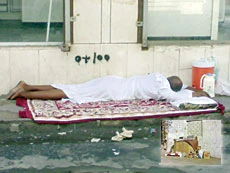
MAKKAH, 13 June 2008 — The number of uncared-for people wandering the streets of Makkah are noticeably on the increase these days. They are by no means illegal visitors to the city, but permanent residents, mostly Saudis. These unwanted men or women, who live on charity, are found under overpasses and on pavements.
There were six such people under the Sulaimania Bridge alone. Most Saudis who live on the streets are drug addicts or victims of some minor mental illness, which makes them feel alienated from society, resulting in their families neglecting them.
Begging is their sole means of livelihood, as they are often not in need of a lot of money. One or two riyals satisfy all of their daily needs. However, a couple of Captagon tablets or a few swigs of illicitly brewed liquor a day is more vital to them than food.
While some live under bridges and pavements, others have homes on the city’s several uninhabited mountainsides.
Muhammad, 80, considers a remote corner under the Sulaimania Bridge as his home. He told Arab News that he loves living there because it is close to Makkah’s historic Ma’ala Cemetery.
Speaking about why he chooses not to live with his family, he said, “I feel like a misfit with them. I cannot understand what they are talking about or their worries. On the other hand, I’m very happy here, close to the people under ground. The people I will soon join.”
Muhammad cooks his own food and sleeps in dirty sheets. “I never beg for money. Some people throw me a few riyals from time to time, which is more than enough for my needs,” he said.
On the other hand, Saleh, who sat on a dirty rug rolled out on a pavement on a side road in the Azizia district, was not ready to talk. He looked like he was in his 60s, his clothes were unclean and he appeared depressed.
After some time, he looked straight at me and asked for a few riyals. I asked him why he wanted the money and volunteered to buy some food for him. He replied angrily that he wanted to buy Captagon tablets. I gave him some money, however, he did not reply to my questions about his relatives and his home.
Ali, who looked around 70, is another weak old man often seen wandering the streets of Azizia. He wears woolen clothes all year round, even in summer. It seems he is mentally ill.
One day I followed him. He crossed some side streets and crawled into a little hut made from cardboard boxes. It was so small he could barely sit upright. When I tried to talk to him, he took out a stick and threatened to strike me.
The only non-Saudi I discovered among these wandering people was a Pakistani woman who also lived under the Sulaimania Bridge. She was definitely not mentally ill. She said she did not have any documents and was an overstayer. She said she sought refuge under the bridge because she did not have a home or relatives in Pakistan to return to. She added that she lived on people’s charity.
The laxity of concerned officials is, undoubtedly, a major factor encouraging the elderly to sleep on pavements. Mental health doctors say such old people pose a threat to themselves, besides creating hygiene problems on the streets.
Dr. Rajab Braisali, director of the Mental Health Hospital in Taif, told Arab News that aged people residing on pavements is a social issue that needs an elaborate study and solution.
Braisali said that those primarily responsible for the welfare of these people are their relatives who refuse to welcome them home. He added that wider society has to play a role in making these people feel belonged. “District officials should try their best to return wandering people to their families,” he said.
If such people are left uncared for, they could be exploited by antisocial elements for drug trafficking, he added. He said that the negligence of relatives could lead to old people becoming depressed and then committing suicide.
Maj. Abdul Mohsen Mayman, spokesman for Makkah Police, said that the police do not interfere in the issue since they have not received any complaint against them. “But if we receive a complaint then we would take them to a mental hospital,” he said.
He dismissed the suggestion that they were drug pushers. However, the general impression among the public is that drug addiction was the root cause of their present state.