
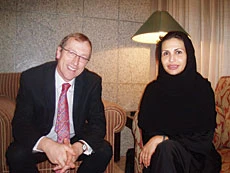
JEDDAH: Pioneering writer, speaker and thinker Mark Goyder is talking about the future of business in Saudi Arabia, and he says big changes are in store and that great opportunities abound. The founder and director of the UK-based Tomorrow’s Company has inspired and challenged the boards, leaders and managers of both large and small companies with his practical insights into the changing agenda for leadership, governance, and stakeholder relationships for a decade.
Tomorrow’s Company teamed up with Asya Al-Ashaikh’s Jeddah-based Tamkeen Development and Management Consulting in 2007, and the two companies hope to change the way people think about doing business.
Goyder was in the Kingdom recently on a visit aimed at highlighting corporate social responsibility. At events organized by Tamkeen, he met Saudi CEOs and business leaders for discussions on challenges facing their companies and evolving a socially beneficial strategy.
During a conversation with Arab News, Goyder spoke of “Tomorrow’s Global Company: Challenges and Choices,” a report in English and Arabic from his organization.
“The report is all about the success of tomorrow’s global company,” he said. “What will tomorrow’s global company need to succeed? What is significant about the report overall is that it is the work of a group of business leaders from around the world. We brought together a number of North American companies, Continental European companies, companies from the UK and companies from India.”
He said the report is the result of an intensive dialogue. “You had in one place around the table more than 300 years of CEO experience, and we met over 18 months with that group,” he said. “People go to Davos, Switzerland, and talk about a problem for an hour, and they come out with a solution. We are talking about something much, much deeper here. We also held dialogues in parts of the world where we didn’t have companies involved. For example, we went to Beijing, Australia, Paris, New York — you can see there is a wide range of dialogue. During that time I also had the benefit of being at the Jeddah Economic Forum and with the Jeddah Chamber of Commerce and Industry, and that was more excellent input to the whole thing.”
He said the findings of the report were surprising. “They didn’t say the purpose of the company was to create value for shareholders. They said that is the measure of its success,” Goyder said. “The purpose of the company is to create goods and services in a way that is ethical, environmentally sensitive and socially responsible. They also said that this purpose of business is important because of the way the world is changing — because of the limits that we are hitting in economic growth.”
Specific priorities
He said companies in the future will have three specific priorities. “The first is to redefine what it means by success, and the report gives lots of examples of companies who have done that who have said ‘How can I do business in a way that still makes me profitable, that gets me closer to the needs of society?’ Second, embedding corporate values will be increasingly important to the success of the company. Values have always been important. At the heart of what we do in business, there is something moral. The third aspect is creating frameworks. We are seeing major failures in international frameworks. We are not dealing with the consequences of our economic success. We now have to deal with them in a global context,” he said.
“What we are seeing is the emergence of the new form of soft international law, which is actually being developed by companies and civil society organizations together,” Goyder said. “First of all, companies identify a problem that a law is not dealing with. It is a market failure.”
Goyder said the memorandum of understanding with Tamkeen benefited both companies.
“What Tomorrow’s Company brings to that agreement is our relationships with companies around the world and our 15 years of work on thought leadership. What Tamkeen brings to the partnership is a deep understanding of what is happening here in Saudi Arabia and thus enabling us to form a relationship that we wouldn’t otherwise form and enabling our agenda to become known in this region.”
Asya Al-Ashaikh said their organizations are succeeding in driving home the point of social responsibility and sustainability. “Goyder is a leader in his field, and this is the kind of credibility that I want to bring to Saudi Arabia,” she said. “I want to serve the private sector in a way that introduces that new paradigm of management and addresses environmental and social issues. Saudi Arabia has a huge impact on the global company, and we need international standards. My aim is to provide those frameworks for the local companies. The concept is new. But people are beginning to understand.”
For now in the Middle East, Goyder said education is the lynchpin. “The quality of skills that are coming out of schools and universities as opposed to the quality of skills companies need to compete on a global scale is the major concern. The role of government was discussed widely. When it comes to corporate social responsibility, the government has to play its role by providing incentives and creating indices.”
Global companies
Goyder said that in addition to being a time of great challenges, it also is a time of great opportunities. “Saudi companies have fantastic opportunities to succeed in this global world,” he said. “If you look at some of the major companies here, I think that the opportunity for some of those companies in this very vast, very global marketplace is fantastic because the world is not going to be shaped by the global companies that were born in London and Detroit. It is going to be shaped by companies being born in Bangalore, Sao Paulo, Shanghai, in Jeddah and Dubai and all around this region. The next generation of global companies won’t take the time their predecessors did. They will learn from those mistakes and adapt very quickly in this multicultural, crossing-boundaries world. They will have the opportunity to be global by design.”
Asya Al-Ashaikh said Tamkeen’s goal is to create a future for business which makes equal sense to staff, shareholders and society.
“We create value with our partners by building a mutually reinforcing link between ideas and implementation — between theory and practice,” she said. “In so doing, we achieve our purpose of pushing the boundaries of thought leadership and business behavior.”