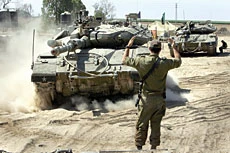
JERUSALEM: Israeli Prime Minister Ehud Olmert warned yesterday that Israel’s imminent truce with Hamas in and around the Gaza Strip could be short-lived and said the military stood ready to act if it failed.
“We have no illusion but that this truce is fragile and could be short-lived. Hamas has not changed its skin,” Olmert said at a conference in Bet Yehoshua, north of Tel Aviv.
Olmert’s warning came just hours before the truce is due to take effect at 6 a.m. today, after Egypt mediated for months between Israel and Hamas to end the bloodshed in and around the impoverished Palestinian territory.
“If terror continues, Israel will have to work to remove the threat,” Olmert said, stressing amid skepticism over the truce. He added that the Israeli armed forces were ready to act if the cease-fire failed.
On the other hand, Israel will ease its blockade of the territory “if the fighting indeed ceases as planned,” the prime minister’s spokesman Mark Regev said. “Israel is giving a serious chance to this Egyptian initiative and we want it to succeed.”
Egypt announced the deal on Tuesday, and Hamas confirmed it agreed to hold its fire.
Top Israeli defense official Amos Gilad underlined after returning from talks in Cairo that the two sides had reached “understandings with Egypt” rather than a formal accord.
In Washington, the White House gave a cautious welcome to the agreement. “We hope this means no more rockets will be fired by Hamas,” said Gordon Johndroe, the White House national security spokesman.
He hoped the deal would also help improve the atmosphere of peace talks between Israel and Palestinian President Mahmoud Abbas, whose writ has been limited to the West Bank since Hamas seized power in Gaza last June.
Abbas, on a visit to Sanaa, hailed the deal as “good news for us.” But skepticism was high among residents on both sides of the border.
Hamas spokesman Fawzi Barhoun, however, insisted that the group would “not give Israel any pretext to violate the truce,” while Abbas urged “all movements within the Gaza Strip to adhere to the truce.”
Islamic Jihad vowed to respect the deal, stressing however it had reservations and saying its fighters had fired off at least nine rockets at Israel from Gaza yesterday.
Israeli authorities said Palestinian gunmen also fired at Israeli civilians working near the border fence. No one was wounded, but Israeli authorities closed down the Nahal Oz terminal that supplies virtually all of Gaza’s fuel.
The violence continued into the final hours, with Palestinian gunmen firing 38 rockets and mortar rounds and Israeli forces conducting air raids.
Two Palestinian gunmen were wounded in airstrikes in northern Gaza, and a woman was hurt when a rocket hit a house in southern Israel, medics and witnesses on both sides of the border said.
Since Hamas seized power, Israel has carried out near-daily raids, killing hundreds of Gazans but failing to halt the rocket and mortar fire that has killed four Israelis over the same period.
Senior Hamas official Khalil Al-Hayya said on Tuesday the truce would initially last for six months.
Gilad, for his part, said he expected Egypt to prevent weapons from being smuggled across its border into Gaza.
Syria, which is the base in exile for Hamas political supremo Khaled Meshaal, said it supported the truce and called on Israel to honor its side of the bargain.
Amid a chorus of international approval, UN chief Ban Ki-moon hoped the truce would “both provide security and an easing of the humanitarian crisis in impoverished Gaza, and end rocket and mortar attacks against Israeli targets.”
And the EU presidency, currently held by Slovenia, commended the Egyptian government for its mediation role and urged “all the parties concerned to abide by the agreed cessation of violence.”
— With input from agencies