
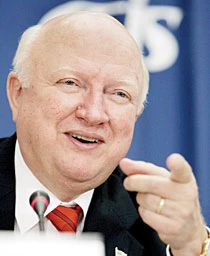
JEDDAH: Oil producers must increase production to ease pain from record fuel prices, said US Energy Secretary Sam Bodman, who is visiting the Kingdom to attend a Saudi-hosted emergency meeting, yesterday.
Bodman also blamed tight supplies for fueling a rally, which lifted oil prices close to $140 a barrel last week.
“World oil demand has increased significantly in the last few years despite higher prices. China, India, and the Middle East are the largest contributors to this growth as they consume more energy to fuel economic growth,” he said.
He further called on global producers to increase production. “Without a sustained increase in global production capacity, markets are expected to remain very tight... Anything that will add supply to the market is important,” he said.
“While increases in near term oil production are welcome and necessary, fundamentally the market needs to see investment in increasing the longer term production capability... The world faces an extraordinary time that, in my view, demands responsible action from both consuming and producing nations,” he said.
Saudi Arabia already has vowed to boost supply next month by 200,000 barrels per day (bpd).
Bodman said this would help lessen the pressure on oil prices in the short run and that other OPEC countries could follow suit according to their capacity to help ease prices.
Bodman said current surplus production capacity is below historic levels and that prices respond when surplus capacity is low, particularly when geopolitical turmoil or other events such as hurricanes threaten supply.
“Market fundamentals show us that production has not kept pace with growing demand for oil, resulting in increasing prices and increasingly volatile prices,” Bodman told reporters ahead of today’s summit that will bring together consuming and producing nations at the Jeddah Hilton to address the global energy crisis.
Between 1973 and 1985, OPEC (Organization of Petroleum Exporting Countries) production fell dramatically, squeezed by anemic demand growth and a strong supply response to higher oil prices by non-OPEC producers. As a result, the net call on OPEC fell by 11 million barrels a day over the period.
In contrast, since 2003, world oil demand has continued to rise, while there has been little supply response from non-OPEC producers. In addition, OPEC production has remained largely flat.
For these reasons, the market has seen a rising call on the key OPEC countries and other major reserve-rich regions. “The market needs confidence that supply will be forthcoming,” said Bodman.
He added that prices would soar higher if more oil was not forthcoming. “In the absence of any additional crude supply, for every one percent of crude demand, we will expect a 20 percent increase in price in order to balance the market... These are very high oil prices. They have a severe impact certainly on the families of the United States, but also on the families of other countries as well,” he said. He added that insufficient oil production, not financial speculation, was driving soaring crude prices.
“There is no evidence that we can find that speculators are driving futures prices for oil,” he said, adding that the commodities markets have experienced a huge influx of money from financial investors in recent years, but they have been following the market upward rather than driving the increase in the price of oil.
Many countries around the world have experienced social unrest as people are angry that rising fuel prices have driven significant increases in the cost of food and other basic goods.
According to the International Energy Agency, rising demand in the developing world has coincided with historically low levels of spare oil production capacity, which fell below two million barrels per day among OPEC countries in May for the first time since the third quarter of 2006.
Bodman made clear that the responsibility for reducing oil prices did not simply fall on the shoulders of producing nations, saying consuming countries must increase energy efficiency and invest in the development of alternative fuels.
Bodman also called for a reduction in fuel subsidies by various countries.
— With input from agencies