
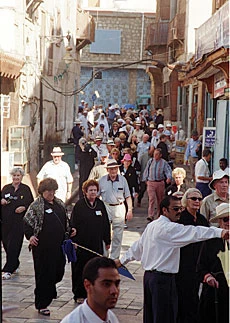
WITH the increasing number of historical sites being opened to visitors in Saudi Arabia, the tourism sector is witnessing unprecedented growth. The logical extension is that with an increase in demand, there is an increase in job opportunities —- especially for women.
But women’s role in this field is still limited. This is because society is still not yet used to the idea of having Saudi women guiding groups of foreigners or Saudis, not to mention traveling from one city to another despite the tempting salaries tour agencies may offer.
In the past five years few unofficial groups have organized tours to the religious sites in Madinah and Makkah, and to historical sites in Jeddah. But these efforts have failed to take off, according to a woman tour operator who did not wish to be named.
While it was hard for many to advertise their operations, others chose another path to highlight the heritage. They prefer to concentrate on the antiquities and focus on presenting different styles of clothing from all around Saudi Arabia to Saudis and foreigners. Salma Alireza is one such woman. One of the founders of Mansoojat, a UK-registered charity foundation, Alireza and 12 other Saudi women run the business with a gallery based in Jeddah containing all the clothing. These are moved around to different areas, and also exhibited outside the country. She gave as an example when Mohammed Abdul Latif Jameel’s Islamic Gallery at the V&A opened in London last year, they participated, and they did it again during the Jeddah Economic Forum in March 2008.
The reason for the few numbers interested in tourism is due to the fact that there’s only one college for tourism in Saudi Arabia. Women can study tourism only at King Saud University’s College of Tourism and Archeology. But other universities are opening the doors for them now. For example, King Abdulaziz University in Jeddah will allow its history department students of either sex to choose either to continue the last three semesters in history or in tourism.
Around 20 women students have already chosen tourism. “It is a new field and I am curious to learn about it,” said 22-year-old Ebtisam Al-Ghamdi one of the students who has applied to specialize in tourism. “Though only 20 have applied, many wanted to join but did not because their families did not like the idea,” she said. Al-Ghamdi believes tourism will allow students to have many options after graduation and to work as professors, in travel agencies, museums and so on. She wished there was a complete department dedicated to tourism and antiquities. Yet this is a good start and she is looking forward to the museum administration course and the two practical courses listed in the study plan. “Most of the courses in the three semesters concentrate more on history and marketing and I hope we’ll really get a clear idea about tourism,” she said, adding that the private sector could help by holding workshops during summer.
Meanwhile, the General Commission for Tourism and Antiquities (GCTA) welcomed the participation of women and has been training them for the past three years. Now they have around 20 qualified Saudi women in different positions —- creating and supervising their project. These women work in sectors that deal with society’s awareness, tourism research and information centers, recreational event planning, and marketing. In addition, they also are on the welcoming committee to receive guests and guests during GCTA-run events and also taking them on tours.
The GCTA is also helping students get bachelor’s and postgraduate degrees in tourism on scholarships abroad. The commission also cooperates with King Saud University by availing itself of the students’ services during their events. The last time these students volunteered was at the 1st Tourism Investment Meeting held in Riyadh at the beginning of 2008. Around 48 students of both sexes volunteered. The founder and general director of Al-Mustakshif Al-Arabi (Arabian Explorer) tourism agency, Fahad Al-Safh said, “This field is new and this will give women a chance to explore something new and advance in it and, I am sure, they will.” Al-Safh said his agency had opened the door for many women to help in the tourism field here, but cultural restraints were holding them back, especially when it came to traveling to cities in the Kingdom. However, he said, when they cooperated with Effat College students during previous summers, “The girls showed great interest, dedication and discipline and those who are serious about entering this field will find many options to explore.”