
A new five-star luxury hotel is under construction in Cape Town — and it is a hotel with a difference for South Africa. Targeted at the growing Middle East market and Muslim clientele in particular, the hotel will not serve alcohol and will offer only halal cuisine.
The Coral International, a project of Dubai-based Coral International Hotels, Resorts and Spas and Cii Holdings together with their South African partners, will operate the hotel, which is situated on the corner of Buitengracht and Wale Street in the city center.
Last month, local real estate agency Pam Golding Properties announced that it had been awarded the exclusive mandate to market 30 out of the 140 luxurious rooms and suites — priced between R2.1-million and R5.8-million (SR1.05 million and SR2.9 million) — for sectional title ownership (time-share). Construction is scheduled for completion by the end of 2009 — coinciding with the final draw for the World Cup football finals to be held in South Africa in June and July 2010.
Hotel facilities will include a state-of-the-art business center with conference and meeting facilities, a fully fitted gym and health center, as well as a prayer room and an outdoor swimming pool. The hotel will also have three restaurants offering a range of cuisines from modern European to Arabic and African dishes.
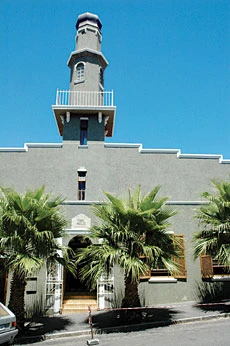
The site of the hotel is on the edge of Bo-Kaap, an area of Cape Town rich in Cape Malay culture. The area is carefully preserved as a historical area and the iconic primary colored homes and steep streets are a major tourist attraction for visitors interested in the history of the Cape. Bo-Kaap also has a reputation for its Cape Malay cuisine and is home to the oldest mosque in South Africa.
The idea of a halal hotel catering for the Muslim market might at first seem slightly odd in the context of South Africa. In fact, it is entirely consistent. Islamic culture and Muslims have a long history in South Africa. The Dutch arrived in the Cape in 1652 and established a trading post around 1654 for ships of the Dutch-East India Company traveling between Holland and the East Indies. The first recorded arrival of free Muslims, known as Mardyckers, was in 1658 from Amboyna, an Indonesian island in the southern Moluccas. They were brought to the Cape in order to defend the newly established settlement against the indigenous people, and also to provide labor.
“Bo-Kaap” or “Cape Malay Quarter” is one of the culturally and historically most interesting parts of Cape Town. Many of the inhabitants are descendants of people from Batavia (now Indonesia), Ceylon (now Sri Lanka), India and Malaysia, who were enslaved in the 17th and 18th century by the Dutch-East Indian Trading Company. Many were Muslims and others were converted to Islam by the Cape Muslim community.
The Cape Malays and their religious leaders played an important role in the development of the language and culture of the Cape colony. The Afrikaans language evolved as a language of its own from Dutch so that slaves would be able to communicate with the Dutch and between themselves, since they came from a variety of countries and cultures.
The Muslim-Afrikaans language movement produced some of the first examples of written Afrikaans with the first Afrikaans publication in Arabic letters printed in 1856. The Cape Muslim leader, Abu Bakr Effendi, translated several Islamic works into Afrikaans for the Cape Muslim community. The Afrikaans translation of the Bayaan-ud-diyn (Revelations of the Faith) in Arabic script was first published in 1877 and is the most well known. Abu Bakr also started a Muslim school in Cape Town with Cape Afrikaans as medium of instruction.
The residents of Bo-Kaap have preserved their cultural and Islamic identity. The old Malay Quarter with its plain artisan houses and Mosques stretches from Buitengracht Street up to Signal Hill. The architectural style probably has have its origins in 17th century Amsterdam.
The history of the Bo-Kaap reflects the political processes in South Africa during the apartheid years. The area was declared an “exclusive residential area” for Cape Muslims under the Group Areas Act of 1950 and people of other religions and ethnicity were required to leave. At the same time, the neighborhood was different from other urban residential areas. It was for example one of the few neighborhoods with a predominantly working class population that continued to exist near a city center. In the mid-twentieth century, most working class people in South Africa were moved to the periphery of the cities under the Slum Clearance Act and neighborhood improvement programs.
The area is also just a few minutes away from the Victoria and Alfred (V&A) Waterfront, a magnificently restored waterfront and dock area that has become the leisure and gastronomic hub of the city. It has also attracted massive investment from the Middle East — particularly from a Dubai and UK-led consortium which bought the V&A Waterfront for more than US$1 billion.
Soaked in history, one of the most beautifully located cities anywhere and now developing rapidly as one of the world’s favorite tourist destinations, Cape Town is gearing up for the flood of visitors anticipated for the carnival of the 2010 FIFA World Cup.