
In a city where modern trends are the in thing, it is truly unique that people are still being swayed by voices from the past, something that bears mute testimony to the strong bond that people have with culture and tradition.
Adapting adeptly to the changing times, the people of Jeddah have shown a tenacity to hold on to their roots — this time to distinctive Hijazi folklore music.
What was a singular event at almost every engagement, wedding and family gathering before fading into the background is now once again coming to the fore with people cherishing the blast from the past — the poems sung by jassises.
A jassis, defined loosely, is a person who sings traditional poems. But he is more than that. The poems, generally folklores that are not set to any meter, have to be memorized and then sung to a set modulation.
What makes a jassis different from other musicians is his strict adherence to an established rhythm that has its roots in time immemorial while relying on his voice for intonation. From the days that the folk music sung by jassises became popular till date, there has been little change in form and style. However, present-day singers have — while still maintaining the classical rhythm in presentation — changed some of the words in verses to gel with modern times. What makes a jassis inimitable is that his rendition has no accompaniment. With no instruments lending support, the jassis has to rely on his voice and immaculate pauses to carry the day.
The verses or poems, which have been passed down the ages, are mostly in narrative-form and sung in varying pitch. Therein lies the mesmerization — for the interaction between the singer and the listener is threaded by the jassis’ stress on words and emphasis on pitch.
Today, there are about 40 to 50 jassis singers who still make the rounds. But what was once an exclusive profession is slowly finding favor with the younger generation who are finding this not only an exceptional hobby but also another source of income.
Attracting the youth
Although youngsters are making inroads with their dedication to this old form of music, it is still the old-timers who have honed the much sought-after voice and skills over the years. Through their words they raise a flutter in hearts and through their lilting voices put bodies in a swoon.
Where the youth are making a pronounced change is in the clarity in diction and modulation. This has helped add new fans from the younger generation to this form of music, as they cannot only comprehend the storyline but also relive the golden period the verses project.
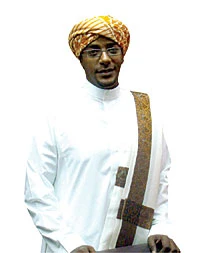
Twenty-seven-year-old Faisal Saeed Al-Omari is a new jassis who wishes to take people to joyous heights, something that he is succeeding at. “It’s the joy that it brings to me and to the people around me that keeps me going on for hours and hours,” he said, while elaborating the reason he is so involved in this form of music.
Al-Omari is confident that folkloric music in this region is going to live on because more and more youngsters are taking to it. “In fact, the one who got me into it was Faisal Labban, who is two years older than me, and Hisham Baroom. I believe many are learning this genre of music because of them — especially Labban, who is dedicating all his time to it,” he said.
Exhaling deeply and fixing his Hijazi scarf on his shoulder, Al-Omari explained that it was his childhood dream to become a jassis.
Although his family had no connection with this style of music, he first made it a hobby before finding encouragement when he began singing at weddings, engagement parties and cultural events inside and outside the Kingdom.
The style and rhythm of this form is somewhat similar to the Urdu ghazal (poetry) and najm (verses), something that helped Al-Omari shift gears to Indian poetry. He has rendered ghazals and Indian songs along with Sudanese songs in several celebrations, and captivates his audiences.
When he was young, every time he heard a jassis at a wedding or an engagement party, the words just tugged at his heart, said Al-Omari. He simply fell in love with it and just went where his heart dictated.
Al-Omari, an executive sales officer for Mobily, said what made singing all the more pleasurable was the fact that it is easy to learn and listen to, while its deep meanings cannot be sensed in other ordinary Arabic music.
Al-Omari, who did not study music but electronic engineering, is slowly finding himself in sync with being a jassis.
“I love them (the verses) and memorize anything I come across. On top of that I love the late Talal Maddah’s songs and folklore,” he said.
He said he is lucky to find a life partner who is understanding and encourages him to sing. “It means a lot to me because this takes the best part of my day and I want to share it with my partner,” he said.
Regarding his wedding day, he said, “If Maddah had been alive then I would have loved to have him sing on the occasion.”
Maddah an inspiration
Al-Omari said Maddah was his inspiration. He is subscribed to www.6lal.com, which is an online forum featuring all the latter’s work in addition to rare samples of songs by him and others.
The forum has around 100,000 subscribers, he said, adding that through it he has expanded his knowledge by interacting with people who share mutual interests.
Through it, he met Ghazi Ali, a venerated Saudi jassis who composed several songs for Maddah. Al-Omari said the first time Ali saw him singing he asked him to visit him, adding that he would give him free lessons. “I was hesitant to take up the offer, but the next day he got my number from someone and asked me to visit him,” he added. “Of course, I benefited from the visit.”
Al-Omari’s passion runs so deep that he hopes to leave an indelible mark in this genre. He said he had recorded four songs, and hopes to make another two before he releases his first album. Today, the past and present do mingle with audiences requesting for jassises are joined with a supporting band.
Al-Omari believes that although jassises perform a joyous service by offering some of the priceless treasure of the yore to the present, it is the people who savor the fare that makes the music live on.