
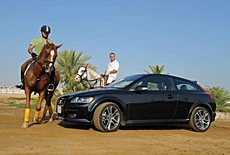
Unless the car is standing in snow, the idea of a “cool Volvo” is, to a whole generation of people, something of an automotive oxymoron. The brand has for decades celebrated safety, functionality, reliability and build-quality and the characteristic breeze-block design seemed a flaring of the corporate nostril at a whole marketplace of younger buyers. That has just changed.
Not since the 1960’s UK television series “The Saint” which provided indelible image of (Sir) Roger Moore driving his Volvo P1800 sports car has the company produced anything even vaguely sporty that really worked well.
There was the Volvo 480 of the mid-1980’s of course. Using the Lego concept of gathering together interesting bits and assembling something new, it was a brave attempt to escape from unutterable dullness, but it did not quite work.
The idea was to design a front-wheel drive car with an integral computer to control its advanced — for the time — electronics. Car based computer technology was very much in its infancy and the 480 was plagued with electrical problems. The car did however have excellent handling, due in to its Lotus-designed suspension, a series of reliable Renault engines and Porsche tuning. Following in the tire tracks of the 1800ES and 480ES, the Volvo C30 is a small two-door coupe with a large glass hatch giving it a unique look and abundant rear visibility. The C30 also sports four bucket seats as did the 480, front-wheel drive, a turbocharged engine and handling that, while sporty, could not claim to be “hot hatch.” The designers of the rather handsome C30 have learned their lessons and avoided the quick-fix look. It does not look like a four-door sedan with the tail docked, which was rather the case of a couple of its nearest competitors the Mercedes 230 and the BMW 318ti. Mechanically identical to the S40, the C30 has the same wheelbase as the sedan but has had about 20cm inches shorter and is fractionally lower and wider making the car some 136kg lighter than its sedan stable mate. The C30’s cargo area however can still hold 0.37 cubic meters with the 50/50-split rear seatbacks up and 0.57 cubic feet when both are dropped. The C30’s front fenders bulge pleasingly at the wheels and the trade-mark rear shoulders are wider than any other Volvo and flow organically on to stylishly molded rear light clusters set either side of a deeply dipping rear window that recalls the P1800ES.
Not the sportiest car on the block, the 2008 Volvo C30 is one of few Volvos in recent memory that could be fairly awarded the laurels of “cool.” Not, I hasten to add, by a sexagenarian driver who found rather that the interior was satisfyingly uncluttered, minimalist in style and elegantly detailed, rather than cool. For example, the signature thin “floating” center console from the S40/V50 has been incorporated into the C30’s layout. It provides stunningly simple ergonomics and is very easy on the eye.
The 2008 C30 uses a single engine set-up, a turbocharged 2.5-liter five-cylinder unit producing 227 horsepower and 236 pound-feet of torque. A six-speed manual is standard in the US and Europe, while a five-speed automatic is optional. The automatic option gives the car a 0-60-mph sprint time in the mid six-second range and charges on all the way to 235 kph. The five-speed automatic transmission offers manu- matic shifting with the gear lever, but no paddle shifters.
What it lacks in performance however, it makes up for abundantly in stability of ride, interior and exterior design and silky drivability. It cleverly melds street credibility and Volvo safety into an elegant cabin and pushes the whole mélange along with nippy if not quite outright sporty alacrity. The driving dynamics of the C30 are very similar to the S40 coupe. Its suspension is firmer but designed with comfort and daily drivability as the target; here the C30 shines. It is fun to drive, but the steering, gearbox and suspension are, compared with the Mini Cooper S and Volkswagen GTI, comparatively comfort-tuned. Inside are four individual seats; the front ones are capacious and very comfortable with supportive back and sides and ample enough for a reasonably large driver and passenger. The impression from the driver’s seat is of a very roomy car with no kerb-side gymnastics needed to get in; the long, heavy doors give plenty of room for access. The driving position, with long seats and telescoping wheel travel, is good for almost any body type. Rearward visibility is excellent thanks to the large all-glass hatch. The rear seats — divided by a narrow arm rest, will accommodate only smallish adults sitting square on. C30 project director Haken Abrahamssen is quoted as saying that “customers will rarely use the back seat,” as the target market is young couples with no children and entry level purchasers.
Available in two trim levels with a host of options, standard equipment on Version 1.0 includes 17-inch wheels, a 50/50-split rear seat, full power accessories, tilt/telescoping leather-wrapped steering wheel and a CD audio system. Version 2.0 offers 18-inch wheels, a sport body kit, a quite phenomenal Dynaudio 10-speaker surround-sound audio system and brushed aluminum style detailing. Among the options are cruise control, bi-xenon headlights, headlight washers, a blind-spot warning system, power-retractable side mirrors, sunroof, park distance control, auto-dimming rearview mirror, power front seats, heated seats, keyless ignition and a navigation system. A sport-tuned suspension — Dynamic Chassis — is also available. The C30 capitalizes on Volvo’s long term concern with safety. Antilock brakes, stability control, traction control, front-seat side airbags, full-length side curtain airbags and a whiplash protection system are all standard equipment. The only niggles I had during the test drive was road and transmission noise. Tire rumble, though never oppressive, was distinctly evident and there was a distinctly perceptible transmission whine at low speeds. These are though genuinely minor niggles. The C30 is really hard to fault. It is not so much a hot hatch as luxuriously warm.