
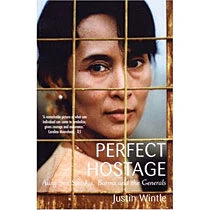
Aung San Suu Kyi has been compared to Nelson Mandela and Mahatma Gandhi. Nicknamed the “titanium orchid”, she has been under house arrest since 1989 and is presently the world’s most famous prisoner of conscience in a little-known country, Burma, renamed Myanmar in June 1989.
Winner of the Nobel Prize in 1991, Suu Kyi symbolizes for many, Myanmar/Burma’s best hope for democratic rule. Despite the change of name, the country is nonetheless, best known as Burma. Moreover, the name Burma is still used by those who oppose the nation’s unelected rulers.
Justin Wintle has penned a well researched biography about Suu Kyi, her father Gen. Aung San and of Burma itself. It not only gives the reader a detailed account of the country’s quest for independence from colonial rule spearheaded by Suu Kyi’s own father but it also offers a balanced account of Suu Kyi’s political legacy.
Suu Kyi’s name means ‘Strange Collection of Bright Victories’, it includes her father’s name, Aung San. In Burma, the names of the sons and daughters of famous people very often include that of their illustrious father. Suu Kyi hardly ever knew her father since he was assassinated when she was only two years old but her mother Daw Khin Kyi, often spoke to her children about their heroic father so they would follow in his footsteps.
In a biography she wrote about Aung San, her father, Suu Kyi describes him as a leader “who put the interests of the country before his own needs, who remained poor and unassuming at the height of his power, who accepted the responsibilities of leadership without hankering after the privileges”.
Suu Kyi’s mother was also endowed with a formidable character. Her widow’s pension was not sufficient to meet her family’s financial needs and Daw Khin Kyi had already decided it was wrong to take the money. She believed it was her duty to help her country and was looking for a dignified position where she could use her administrative talents. She worked for twenty years in public service and in 1960 became the first woman to be appointed an ambassador by the Burmese government. She was posted to India but in 1967 took the decision to retire because she felt she could no longer represent a country ruled by a dictator.
Suu Kyi’s life changed when she was accepted at Hugh’s College, Oxford to study politics, philosophy and economics. She was remembered then for her exotic appearance: She nearly always wore Burmese longyi and adorned her hair with flowers she picked up from the college’s gardens, a habit she inherited from her mother Khin Kyi.
One of her fellow students, Dr Margaret Stearn remembers that Suu Kyi had the ability “of putting one on one’s best behavior, not in the restrictive sense, but in the sense of bringing out the best in you. In her company I always felt a better person” she says.
When Suu Kyi finished her studies, she decided not to return to Burma. Her country was ruled by a totalitarian and unelected government and her mother had decided to break her relationship with the regime. Furthermore, she had met the man she was going to marry, Michael Aris. With the help of the UN secretary-general, the Burmese, U Thant, she secured a job at the United Nations, an experience which would help her later when she became a political activist.
Before her wedding which took place in 1972, she made it clear that one day she would return to Burma to help her people. Sixteen years would pass before Suu Kyi flew back to her native country. Suu Kyi arrived in Rangoon in April 1988 to be at the side of her sick mother. Those who met her at that time, especially during the summer, unanimously agree that she looked like her father, in manner as well as looks. In The Voice of Hope which was published in 1997, Suu Kyi wrote that she first took part in the movement for democracy out of a sense of duty “on the other hand, my sense of duty was very closely linked to my love for my father. I could not separate it from the love for my country, and therefore from the sense of responsibility toward my people”.
When Suu Kyi realized her mother would not recover, she decided to bring her back home so she would spend her last days in familiar surroundings. Her husband, Michael Aris, who was there at the time with both their sons wrote that: “Suu’s house quickly became the main center of political activity in the country… Every conceivable type of activist from all walks of life and all generations poured in. Suu talked to them all about human rights, an expression which had little currency in Burma till then.”
As time went buy, Suu Kyi became more conscious of the difficulty of her task but she always insisted on following the principles of non violence which meant everything to her: “Suu Kyi’s position was that to resort to force of any kind, however physically inconsequential, would fatally damage the principles she stood for. Any victory gained by violence could only perpetuate violence, and it was Burma’s historic culture of violence that she wished to dismantle,” writes Wintle.
The future proved that Suu Kyi had inherited her parent’s fine qualities. She also shared with them a profound and everlasting love for Burma and its people. After she had hesitated in forming a political party, she decided it was in her country’s interest to contest the elections with an opposition party. With the help of Aung Gyi and U Tin Oo, she formed the National League for Democracy. Although she never lost her graceful manners, she managed gradually to be less reserved in front of strangers. She also showed a remarkable ability to relate to anyone. By the time she was placed under house arrest in July 1989, she became an icon and the world’s most famous prisoner of conscience. The Burmese authorities confiscated her correspondence and prevented her from receiving any money. They offered to pay off her living expenses which she adamantly refused. To cover her food expenses, she sold pieces of furniture, a bathtub and an air-conditioning.
Two years later on Oct. 14,1991, she was awarded the Nobel Peace Prize. In the original citation Suu Kyi was described as “one of the most extraordinary examples of civil courage in Asia in recent decades”. And Vaclav Havel who nominated her for the prize wrote “she is an outstanding example of the power of the powerless”.
Looking back on Suu Kyi’s political achievements, the author speaks of the “triumph of failure” adding that “rightly principled positions have turned into inflexible dogma, a charge sometimes leveled at Suu Kyi but Wintle recognizes that what needs to be applauded is her “phenomenal ability to inspire others… Without her kind we are all impoverished”.