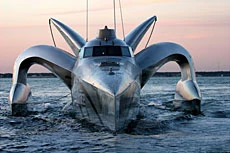
THIRUVANANTHAPURAM: Earthrace, claimed to be the world’s fastest, coolest and greenest powerboat, called at the Kochi port last week on its second attempt to beat the record for the fastest powerboat circumnavigation and to promote green fuel.
At Kochi, it smashed its own record time for a port stop, refueling in just 90 minutes, and it was 2,331 nautical miles ahead of the world record as it thundered through the Indian Ocean toward Oman with 18,351 nautical miles under the crew’s belt and just 5,500 to go to the race’s finish line.
Cochin Port Trust, GAC world shipping, Michael’s Land Resort and local supporters rallied together to help Earthrace achieve the record within the record bid. “The speedy turnaround has helped the crew to claw back valuable time which was lost due to weather conditions and essential maintenance in Singapore. We’re all really stoked about how quick and efficient the turnaround was in Cochin Port,” said Skipper Pete Bethune.
“We’re 46 days into the race now and we’ve got our sights firmly set on the world record. Everything else we do — eating, sleeping — is just a way of filling time between now and arriving back in Spain. But that’s not to say we’re home free just yet — the next leg could be tricky as we navigate through ‘Pirate Alley’ and attempt to stay out of trouble.”
Canadian guest crew Paul Manifould disembarked here making room for new guest crew David Howard, an ex-British Royal Navy marine engineer, and a resident of Abu Dhabi. “We’re proud to be stopping in Kochi, as it has a strong connection to one of the greatest figures in nautical history. Vasco da Gama was the first person to circumnavigate the globe. He died here and he was buried here. We are following his example over five centuries later, but with a couple of engines and a lot more horsepower,” the skipper said. The New Zealander who is also founder of the project believes that Earthrace has a great opportunity to nourish and grow the European bio-diesel industry as well as to advance bio-diesel as a genuinely viable alternative.
The 78-ft bio-fueled trimaran had perfect conditions as it ran northwest in the sheltered waters of the Malacca Straits. Conditions deteriorated once she reached the Indian Ocean. The southwest monsoonal winds have delivered 20-25 knots and three to four meter seas on the port beam slowing the giant wave-piercing craft. After having started from Sargento in Spain on April 27, the craft set for the Indian destination after repairs and refueling with 100 percent renewable bio-diesel during the three-day stopover at the Singapore marina, one of the vessel’s sponsors.
Before reaching Singapore, she made stops in the Azores April 30, Puerto Rico May 4, Panama May 8, Maui, Hawaii and May 20 and powered into the Pacifica Docks at Majuro, the capital of the Marshall Islands, May 24. It reached Koror and Palau on May 31.
“We believe it is a great reminder of the race against time to protect our planet,” said Mohan Nainan of Earthrace. Despite the delays for repairs, the boat is still much ahead of the world record pace, set by the British Cable and Wireless team in 1998. The trimaran sustained significant damage in Palau and had to complete the last leg of the journey on one engine. Bethune had auctioned off his home and sold his company to fund the building of the $3 million boat. There have been five attempts, including his own first attempt last year, since the current record of 74 days, 20 hours, 58 minutes was set ten years ago.
The Earthrace has a net zero carbon footprint, making it one of the world’s most environment friendly powerboats. The average speed so far has been between 16 and 20 knots as against its maximum capacity of 40 knots. The fuel is derived mainly from animal fat, soybeans or other forms of bio-diesel. The boat has two 540 hp diesel engines fueled with 100 percent bio-diesel and is made mostly of carbon composite, showcasing environmentally friendly technologies such as low-emission engines, nontoxic antifouling paint and efficient hull design.
On its first attempt, the boat departed from Barbados on March 10, 2007 but encountered significant delays including problems with the propellers and other mechanical problems. On the night of March 19, 2007, while around 22km off Guatemala coast, Earthrace collided with a local fishing boat. No Earthrace crew was hurt but one member of the fishing boat crew was killed. The attempt was abandoned two months later after a crack was discovered in the hull. This time, Earthrace has had two bad passages from the Hawaii to the Marshall Islands and from Palau to Singapore.
Just as the Sydney to Hobart big boats skippers know you have to get to the finish line to win the race, Bethune knows his priority is to preserve the boat if he is to take the decade old world record.
Port and tourism authorities here are elated at the prospects of prominence that the record-seekers had brought to Queen of Arabian, which is readying to host the Volvo Ocean Race in December. The fleet of racing yachts is scheduled to reach Kochi on Dec. 3 and remain here for 10 days before leaving for Singapore. Kochi is the second stopover after Cape Town. The round-the-world marathon sailing will begin from Alicante in Spain in October 2008 and cover more than 39,000 nautical miles, visiting 11 ports across the world before reaching the finishing line at St. Petersburg.