
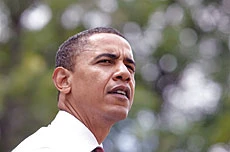
WASHINGTON: Sen. Barack Obama celebrated America’s 232nd Independence Day in Butte, Montana.
He also tried to put recent criticism behind him regarding statements he made Thursday that he might “refine” his policies for Iraq after meeting with military commanders there later this summer.
But when Republicans pounced upon his remarks, and accused him of “flip-flopping,” he held a second news conference hours later to emphasize his commitment to the withdrawal of all combat troops from Iraq within 16 months of taking office.
“We’re going to try this again,” Obama said.
“I have said throughout this campaign that this war was ill-conceived, that it was a strategic blunder and that it needs to come to an end,” he said.
“I have also said I would be deliberate and careful about how we get out. That position has not changed. I am not searching for maneuvering room with respect to that position.”
The evolving situation in Iraq has, in fact, tested both candidates. McCain, whose support for the war helped him win the Republican primary campaign, now finds he must explain his position to an electorate largely weary of the war.
For Obama, who recently changed his positions on campaign finance and a wiretapping law, the suggestion that he was also changing course on a central premise of his candidacy holds particular peril. While Obama has long said he would consult commanders in the field when withdrawing troops, that point might have been lost on many Democratic primary voters who supported his call to end the war.
However, he has recently spoken less about withdrawal and has increasingly emphasized the failure to achieve political reconciliation in that country. In recent weeks Obama has spoken more of the economic costs of the war and the fact that it limits the United States’ ability to send troops to fight what he considers the nation’s primary security threat: Al-Qaeda and the Taleban in Afghanistan.
McCain’s support for the war, meanwhile, could pose problems for him in November. To that end, the Arizona senator, too, has shifted his emphasis. After being criticized for saying he would keep troops in Iraq for up to 100 years if necessary, McCain gave a speech this spring suggesting he would remove most troops by 2013.

