ABU DHABI: The UAE yesterday waived all of nearly $7 billion Iraq owed the emirates and appointed an ambassador to Baghdad.
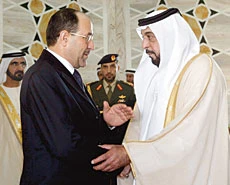
The announcements were made by UAE President Sheikh Khalifa ibn Zayed Al-Nahyan during a reception he held for visiting Iraqi Prime Minister Nuri Al-Maliki at Al-Buteen Palace in Abu Dhabi.
State news agency WAM said the principal debt owed by Iraq to the UAE totaled $4 billion loaned at different times. Sources told Arab News that with interest accruing on the principal over time the total debt amounted to just under $7 billion.
Maliki, in office since May 2006, thanked the UAE for the debt cancellation, telling a meeting with local businessmen in Abu Dhabi that it was a “swift and courageous” decision.
WAM quoted Sheikh Khalifa as saying he hoped canceling the debt would lighten the “economic burden” facing Iraqis, whom he urged to unite behind Maliki’s government.
Iraq has been appealing for relief of at least $67 billion in foreign debt — owed mostly to Arab countries which have been reluctant to forgive Iraq’s belligerence during Saddam Hussein’s regime.
In addition, the UN Compensation Commission says $28 billion remains to be paid for Iraq’s 1990 invasion of Kuwait. Iraq now gives 5 percent of its oil revenue to meet the compensation claims.
Last year Saudi Arabia pledged to cancel 80 percent of more than $15 billion in Iraqi debt. Kuwait, owed $15 billion, has yet to write off.
The UAE also appointed its former envoy to India, Abdullah Al-Shehi, to Iraq as its new ambassador. According to sources, UAE intends to reopen its embassy in Baghdad by the end of the year.
The UAE withdrew its top envoy from Iraq in May 2006 after one of its diplomats was kidnapped and held for nearly two weeks by militants. No ambassador from any Arab country has been stationed permanently in Baghdad since Egypt’s envoy was kidnapped and killed shortly after arriving in 2005.
Maliki’s American backers have pushed Gulf states like the UAE to restore ties with Iraq, where violence has come down by 70 percent over the past year. Jordan, Iraq’s neighbor to the west, has named an ambassador last week, and Kuwait and Bahrain say they will follow suit.
Sheikh Khalifa said Abu Dhabi’s decision to reopen its embassy in Baghdad underlined its belief in “the importance of Iraq’s interaction with its Arab environment.”
Saudi Arabia said in April it would reopen its embassy in Iraq only when security is restored.
Most Western diplomatic missions in Baghdad are located in the US-protected Green Zone, a large swath of land on the west bank of the Tigris River.