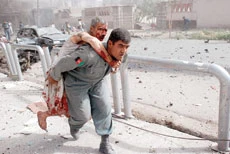
KABUL: A suicide bomber rammed an explosives-laden car into a diplomat’s car at the Indian Embassy in Kabul yesterday, killing 41 people and wounding nearly 150 others in the deadliest attack here since the 2001 fall of the Taleban.
The blast in the heart of the city scattered human flesh and severed limbs in front of the embassy compound, tearing down an outside security office and part of a wall. Charred and bloodied bodies littered a road outside. “The toll of casualties we have so far is 41 dead and 147 wounded. Among those killed are six policemen,” Afghan Interior Ministry spokesman Zemarai Bashary said. Many of the dead were Afghans who had applied for Indian visas.
In New Delhi, India’s foreign minister said the country’s military attaché and a diplomat were among four Indians killed in the attack. Foreign Minister Pranab Mukherjee identified the diplomats as Defense Attaché Brig. R. Mehta and Political Counselor V. Venkat Rao. The two others were security guards. He said India would be sending a high-level delegation to Kabul in the coming days.
The suicide bomber’s car rammed the vehicle of one of the Indian diplomats as it was driving into the embassy compound in the city center, Ambassador Jayan Prasad, who was not hurt in the explosion, said.
The diplomat’s body was flung onto the roof of a nearby building and found several hours later, an embassy official said on condition of anonymity. His Afghan driver was also among the dead.
Five Afghan secwurity guards and two Indonesian diplomats were hurt at the nearby Indonesian Embassy, which was also damaged, Indonesian President Susilo Bambang Yudhoyono was quoted as saying in Jakarta.
The blast was the worst in Kabul since the start of an insurgency launched after the hard-line Taleban were toppled from government by US-led forces for harboring the Al-Qaeda network after the 9/11 attacks.
The Taleban have carried out a wave of suicide bombings across the country in the past seven years, but a spokesman for the movement denied his group was involved in the embassy attack.
“We have not done it,” spokesman Zabihullah Mujahed said.
The militants have previously denied involvement in attacks with high civilian casualties but authorities often blame them, pointing to their record of suicide bombings.
The Afghan Interior Ministry said “terrorists” had carried out the attack “in coordination and with advice from regional intelligence circles.” Asked if this was a reference to Pakistan, Bashary declined to comment.
President Hamid Karzai blamed the “enemies” of the good relationship between Afghanistan and India. He telephoned Indian Prime Minister Manmohan Singh to offer his condolences and said his government would do all it could to find the attackers, his office said in a statement. India has provided significant support to Afghanistan’s efforts to restore order after the ouster of the Taleban, which seized power in 1996.
“Such acts of terror will not deter us from fulfilling our commitments to the government and people of Afghanistan,” Indian Foreign Ministry spokesman Navtej Sarna said.
The United States and European Union led international condemnation of the blast, pledging to stand by Afghanistan as it battles a growing wave of extremist violence in the region.
Pakistan joined in the chorus of condemnation. Foreign Minister Shah Mehmood Qureshi expressed his “profound condolences to the bereaved families.