
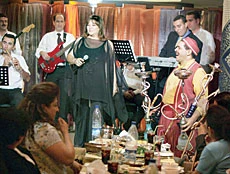
Things are quieter now in Beirut and visitors are coming back. A cosmopolitan city beside the Mediterranean Sea, Beirut is famous for its friendly people and infectious joie de vivre. During the Israeli war in 2006, when fighting was raging downtown, people were sitting in cafes nearby and a number of restaurant owners quickly opened outlets in the mountains where many Lebanese and tourists had sought refuge.
More than any other capital in the Middle East, Beirut is a city where East meets West; it has even been called “Paris of the East.” Beirut is quintessentially, a vibrant, energetic city, bustling with possibilities, a city which reflects the unparalleled Lebanese resilience.
Cruising through the fashionable Verdun Area, you see café tables spill out onto the pavement and beautiful people sitting around drinking and smoking the delicious-smelling apple and strawberry flavored hookah pipes. Lebanese people are known for living as if they were going to die tomorrow and for partying as if they were going to live forever.
Despite its violent past, Beirut is proud of its 6,000-year history. Built on the largest promontory of the coast, the near center of the country, its earliest name was “Birot”, a Semitic word meaning “well” or “source.” When the neighboring towns of Sidon and Tyre began to decline in the first millennium, Berytus, as it was then called, acquired more influence. However, it was not until Roman times that it became an important port and cultural center with its famed Roman law school. After Roman power waned, Greek influence dominated in the Byzantine period beginning in the 4th century A.D. Later, the Crusaders held the city for some 200 years. It was only at the end of the 19th century, after 400 years of Ottoman rule that Beirut began to develop and modernize.
The city center was completely destroyed during the 1975-1990 civil war but soon after, the Taif Agreement, which brought peace back to Lebanon, plans were made to reconstruct and develop this devastated area.
The French-built center of Beirut, is known as “downtown” or “Solidere”. Solidere is the name of the scheme whereby part of the city was privatized and shares sold to the public to raise money for rebuilding. A part of the funds were spent on excavating the old Roman ruins which have been subsequently fenced off and protected from the building frenzy that has seen high rise buildings spring up all over Beirut and the neighboring mountainous hills.
The “down town” area, close to the port and the seafront, used to house Beirut’s traditional “souks;” it has been completely and magnificently renovated thanks mainly to the efforts of former Lebanese Prime Minister Rafik Hariri who set up the Solidere scheme. The “downtown” quarter is more than ever the heart of the capital, a lively and stylish area where everyone can find fun, fashion and food.
Hot and humid in the summer, cool and rainy in the winter, the best time to visit Beirut is during the fall and the spring. A trip to the world famous Jeita Grottos is a must and it can be done throughout the year. Situated about 18 kilometers along the highway north of Beirut in the valley of Nahr El Kalb, the Jeita Grottos consist of two galleries. The visit is conducted by boat, since the caves are home to an underground lake. The immense Upper Gallery is dotted with a forest of stalagmites and stalactites: A magical sight. In 2002, the Jeita Grottos were awarded the Sustainable Development in Tourism Prize by a panel of International Scientific Experts in recognition of the degree of excellence of its care in the preservation of the environment combined with the economic feasibility of the project and impact on local economic development.
There is so much to keep you busy in Beirut that many visitors do not even find the time to enjoy the beauty of Baalbeck, Tyre, Saida, Tripoli or the cedars of Lebanon. Summer is a good time to see the famous cedars because the roads near the summit of the mountains are closed in the winter. The trip to the cedars takes you along winding roads looking into steep ravines and lush valleys. There are only about 350 cedars left in a region which used to be covered with forests of the trees whose precious and aromatic wood has been sought after since ancient times.
If you have no intention of leaving Beirut, do not miss the following landmarks: Jounieh’s cable-car which offers you a fabulous view of the Bay of Beirut, the Roman Baths discovered in 1960s and restored in the late 1990s and Al Omari Mosque, one of Beirut’s oldest intact buildings and one of the few mosques that dates back to the 13th century.
There is something unique about Beirut. Is it the vitality of its people? Their eternal optimism? Their hospitality? Their passion for life? Their love for their country? Their extraordinary resilience? Undoubtedly all of this together!
Useful websites: www.lebanontourist.com, www.bestinlebanon.com,
www.lebguide.com